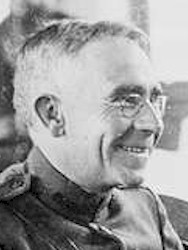
Thomas E. Swan was born in England and, after emigrating to the United States, he was ordained an Episcopalian Priest by Bishop Potter at the Cathedral in Garden City, New York, in 1897. After ordination he served as a missionary in West Virginia for ten years, and then entered the U.S. Army in 1909 and was commissioned as a chaplain. He served during World War I, earning a Distinguished Service Cross, and continued in military service as a chaplain for 27 years, including three years of service at Corregidor in the Philippine Islands. He retired in 1936 as a U.S. Army colonel. In 1950 he celebrated the 35th anniversary of his ordination at Saint Margaret’s Episcopal Church, where his was assisted by his son John, who served with the Army Air Forces during World War II. His other son served as a judge advocate in the Army, and his three daughters all married U.S. Army officers.

Sponsored by:

–
Cemetery:
Awards Received
-

Distinguished Service Cross
-
Distinguished Service Cross
Service:
United States ArmyRank:
Captain (Chaplain’s Corps)Regiment:
125th Infantry RegimentDivision:
32d Division, American Expeditionary ForcesAction Date:
July 31 – August 6, 1918
War Department, General Orders No. 124 (1918)The President of the United States of America, authorized by Act of Congress, July 9, 1918, takes pleasure in presenting the Distinguished Service Cross to Captain (Chaplain’s Corps) Thomas E. Swan, United States Army, for extraordinary heroism in action while serving with 125th Infantry Regiment, 32d Division, American Expeditionary Forces, between the Marne and Vesle Rivers, July 31 to 6 August 1918. During the heavy fighting near the Ourcq River Chaplain Swan was in the front lines at all times, under heavy machine-gun and artillery fire throughout the day and night, comforting and aiding the wounded. On one occasion he crossed a field 200 yards wide, under violent shell fire, to minister to two soldiers who had been mortally wounded. In the operations near Mont Saint Martin, he continually went back and forth over the crest of a hill during heavy artillery fire to care for the wounded.