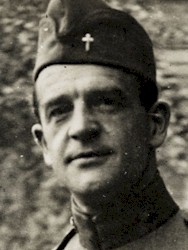
Lyman Rollins received his education at the New Hampton Institution, Bates College (1906), Newton Theological School (1911) and Episcopal Theological School (1912). An Episcopalian minister, he was commissioned in the U.S. Army Chaplains Corps, serving in World War I, where he was cited for gallantry in action. Upon returning from the war, he pastored Saint Michael’s Protestant Episcopal Church in Marblehead, Massachusetts.

Sponsored by:

Lyman
Rollins
1881-04-21
–
1930-07-11
Born:
Concord
,
New Hampshire
Home:
Concord
,
New Hampshire
Buried:
Concord
,
New Hampshire
Cemetery:
Blossom Hill Cemetery
Awards Received
-

Silver Star
-
Silver Star
Service:
United States ArmyRank:
First Lieutenant (Chaplain’s Corps)Regiment:
102d Infantry RegimentDivision:
26th Division, American Expeditionary ForcesAction Date:
September 17 – 18, 1918
Headquarters, 26th Division, American Expeditionary ForcesBy direction of the President, under the provisions of the act of Congress approved July 9, 1918 (Bul. No. 43, W.D., 1918), First Lieutenant (Chaplain’s Corps) Lyman Rollins, United States Army, is cited by the Commanding General of the 26th Division, American Expeditionary Forces, for gallantry in action and a silver star may be placed upon the ribbon of the Victory Medals awarded him. Chaplain Rollins distinguished himself by gallantry in action while serving with the 102d Infantry Regiment, 26th Division, American Expeditionary Forces, in action in France, on 17 – 18 September 1918. Following artillery preparation, Chaplain Rollins accompanied a patrol from the 2d Battalion, 102d Infantry Regiment, to conduct a small arid on the town of Saint Hillaire, then occupied by the Germans. As they approached the village, Chaplain Rollins boosted one soldier up a tree to see if he could locate the positions of machine gun and artillery piece that were firing on the party. In the face of intense artillery and machinegun fire, the soldiers from this patrol caused much havoc and execution among the enemy, forcing them to evacuate the town.