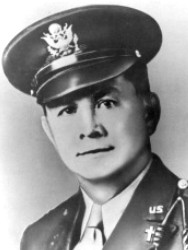
George Fox ran away from home at age 17 and lied his age to enlist in the Army, joining the Ambulance Corps at Camp Newton Baker in Texas under the name George J. Cassatta. He served during World War I, earning a Silver Star, Purple Heart, and French Croix de Guerre. Following the war he completed high school and in 1919 changed his name to George Arnold Lansing. He was subsequently adopted by Percy L. and Florence L. Fox, and again changed him name to George Lansing Fox in 1920. He married in 1923. He studied at Moody Bible Institute and Illinois Wesleyan University, graduating in 1931. He pastored briefly in Downs, Illinois and Rye, New Hampshire, before attending the Boston University School of Theology, and was ordained a Methodist minister in 1932. He assumed pastorate of a church in Waits River, Vermont, and became state chaplain and historian for the American Legion. Following AmericaÕs entry into World War II, he rejoined the Army in 1942 as a U.S. Army Chaplain. On the same day that he enlisted, his son Wyatt enlisted in the Marine Corps. At the chaplainÕs school at Harvard he became close friends with three other chaplains, each of different denominations, and the four of them deployed together for the European Theater of Operations. En route, their troop ship the U.S.A.T. Dorchester, was torpedoed in the North Atlantic. All four chaplains, still close friends despite their differences in denomination, rendered aid and comfort during the sinking of the ship, and gave up their life jackets to other soldiers. Their heroic deaths immortalized them as “The Four Immortal Chaplains of World War II.”

Sponsored by:

–
Cemetery:
Awards Received
-

Distinguished Service Cross
-

Silver Star
-
Distinguished Service Cross
Service:
United States ArmyRank:
First Lieutenant (Chaplain’s Corps)Division:
U.S.A.T. DorchesterAction Date:
February 3, 1943
War Department, General Orders No. 93 (December 28, 1944)The President of the United States of America, authorized by Act of Congress, July 9, 1918, takes pride in presenting the Distinguished Service Cross (Posthumously) to First Lieutenant (Chaplain’s Corps) George Lansing Fox (ASN: 0-485690), United States Army, for extraordinary heroism in connection with military operations against an enemy of the United States. On the night of 3 February 1943, the U.S.A.T. DORCHESTER, a loaded troop transport, was torpedoed without warning by an enemy submarine in the North Atlantic and began to sink rapidly. In the resulting confusion and darkness some men found themselves without life jackets and others became helpless through fear and the dread of plunging into the freezing water. Chaplain Fox with three fellow Chaplains, moved about the deck, heroically and calmly, encouraging the men and assisting them to abandon ship. After the available supply of life jackets was exhausted they gave up their own and remained aboard ship and went down with it, offering words of encouragement and prayers to the last. Chaplain Fox’s great self-sacrifice, personal bravery and zealous devotion to duty exemplifies the highest traditions of the military forces of the United States and reflect great credit upon himself, the Chaplains Corps, and the United States Army.
-
Silver Star
Service:
United States ArmyRank:
Private First ClassBatallion:
115th Sanitary TrainDivision:
40th Division, American Expeditionary ForcesAction Date:
World War II
Headquarters, 40th Division, American Expeditionary Forces, Citation OrdersBy direction of the President, under the provisions of the act of Congress approved July 9, 1918 (Bul. No. 43, W.D., 1918), Private First Class George J. Cassata, United States Army, is cited by the Commanding General, 40th Division, American Expeditionary Forces, for gallantry in action and a silver star may be placed upon the ribbon of the Victory Medals awarded him. Private First Class Cassata distinguished himself by gallantry in action while serving as a Medical Orderly with the 157th Ambulance Company, 115th Sanitary Train, 40th Division, American Expeditionary Forces, throughout four campaigns, in World War I.