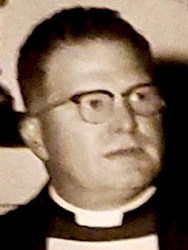
Charles Schilling was born and raised in Marietta, Georgia, where he graduated from public schools. He completed one year of pre-law training at the University of Virginia, receiving his bachelor of arts degree at the University of Georgia, and his bachelor of divinity degree at the University of the South in Sewanee, Tennessee. He also completed the course of training at the Cincinnati (Ohio) Summer School of Social Service. Ordained an Episcopal priest in June 1934, and was elevated to the priesthood in 1935, he served as canon of the Cathedral of Saint Philip and rector of the Church of Our Savior in Atlanta, Georgia. In 1941 he became rector of Trinity Church in Saint Augustine, Florida, where he served until he entered military service in June 1942, and was commissioned as a U.S. Army chaplain. After the war he returned to Trinity Church, and in 1948 accepted a call to be the new rector of Saint Paul’s Church in Augusta, Georgia, where he served for 14 years. From 1962 to 1968 he was rector of St. John’s Episcopal Church in Hollywood, Florida.

Sponsored by:

–
Born:
,
Home:
,
Buried:
,
Cemetery:
Awards Received
-

Silver Star
-
Silver Star
Service:
United States ArmyRank:
Captain (Chaplain’s Corps)Regiment:
175th Infantry RegimentDivision:
29th Infantry DivisionAction Date:
July 29, 1944
Headquarters, 29th Infantry Division, General Orders No. 155 (May 11, 1945)The President of the United States of America, authorized by Act of Congress July 9, 1918, takes pleasure in presenting the Silver Star to Captain (Chaplain’s Corps) Charles Frederick Schilling (ASN: 0-282601), United States Army, for gallantry in action while serving as a Chaplain with the 175th Infantry Regiment, 29th Infantry Division, in action in Normandy, France, on 29 July 1944, in the vicinity of Villabaudon. Company L, spearheading the attack for the 3rd battalion, encountered fierce enemy resistance, suffering the loss of the company commander who was killed. The combat efficiency of the company had deteriorated through attrition and loss of morale. Chaplain Schilling, realizing the gravity of the situation, made an effort to visit every member of the company in the forward positions and by his coolness and courage under enemy fire instilled in the men renewed confidence. When the platoon resumed the attack, it did so with conspicuous success. Chaplain Schillings fortitude and unselfish devotion to duty, without regard for his own life, were in keeping with the highest traditions of military service and reflect great credit upon himself and the United States Army.