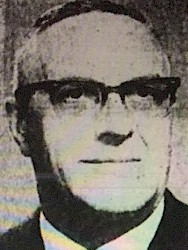
Edgar Stohler attended North Dakota Teacher’s College in Valley City, North Dakota, and then Jamestown College in Jamestown, North Dakota. He and his wife graduated from the Salvation Army’s Training College and began ministry with the Salvation Army. He served as auxiliary chaplain at Fort Custer in Hardin, Montana, and moved to Battle Creek, Michigan, where they were directors of the U.S.O. club and other local clubs. In 1940 he volunteered for military service and was commissioned a U.S. Army chaplain. Before entering active duty he moved his family to Ipava, Illinois, where during his service in World War II, Mrs. Stohler, a Salvation Army captain, became director of a new U.S.O. club there. After the war he began a hospital career as administrator for Catherine Booth Hospital in Chicago, and internal auditor at Presbyterian Hospital, also in Chicago. From 1950 to 1964 he served as director and administrator for the construction and operation of Memorial Hospital, in Johnson. He later served in the House of Delegates of the American Hospital Association, and as president of the Tennessee Hospital Association.

Sponsored by:

–
Born:
,
Home:
,
Buried:
,
Cemetery:
Awards Received
-

Silver Star
-
Silver Star
-
Silver Star
Service:
United States ArmyRank:
Captain (Chaplain’s Corps)Regiment:
358th Infantry RegimentDivision:
90th Infantry DivisionAction Date:
July 23, 1944
Headquarters, 90th Infantry Division, General Orders No. 78 (October 19, 1944)The President of the United States of America, authorized by Act of Congress July 9, 1918, takes pleasure in presenting the Silver Star to Captain (Chaplain’s Corps) Edgar H. Stohler (ASN: 0-530458), United States Army, for gallantry in action against an armed enemy while serving as a chaplain with an Infantry Battalion of the 358th Infantry Regiment, 90th Infantry Division, in the vicinity of Seves, France, on 23 July 1944. His battalion was ordered to take the Island of Seves on 23 July. The attack jumped off as scheduled, but was met with withering mortar, artillery, and small arms fire. The casualties were so heavy that the battalion became disorganized, and the objective was not reached in strength enough to capture it and hold it. During the attack on an island, intense enemy mortar, artillery, and small arms fire resulted in many casualties. In the flat space on the approach to the island all casualties could not be reached, due to heavy machine gun and small arms fire, and the battalion was at a loss as to how to retrieve the wounded. Chaplain Stohler volunteered to attempt to contact the enemy for a short cessation of fire, during which time he would be able to rescue the wounded. He, with Chaplain Joseph Esser, walked straight into the German positions, completely disregarding the danger, in spite of the fact that he had been cautioned that it was practically a suicide mission. He was received by a German officer and arrangements were made to evacuate the American wounded. This took place only a few minutes before a scheduled bombing mission went into action over the spot where the Chaplain was negotiating with the German officer, an attack Chaplain Stohler was aware was planned. On his return, after the wounded had been evacuated, he was strafed by our own planes. His gallantry inspired all who witnessed it and was in accordance with high military tradition.
-
Silver Star
Service:
United States ArmyRank:
Captain (Chaplain’s Corps)Regiment:
358th Infantry RegimentDivision:
90th Infantry DivisionAction Date:
December 6, 1944
Headquarters, 90th Infantry Division, General Orders No. 6 (1945)The President of the United States of America, authorized by Act of Congress July 9, 1918, takes pleasure in presenting a Bronze Oak Leaf Cluster in lieu of a Second Award of the Silver Star to Chaplain (Captain) Edgar H. Stohler (ASN: 0-530458), United States Army, for gallantry in action against the enemy while serving as a chaplain with the 358th Infantry Regiment, 90th Infantry Division, in the vicinity of Pachten, Germany, on 6 December 1944. During an attack on the town, heavy enemy resistance was encountered, and several men were wounded. Voluntarily, and at the risk of his life, Chaplain Stohler accompanied the assault companies across the Saar River and entered the town with the surgical group. There he, though constantly subjected to devastating fire, assisted in administering first aid to the wounded and giving spiritual comfort to all. His presence at the forward aid station and his courageous actions were a source of inspiration to those who were still on the fighting front. The gallant actions and dedicated devotion to duty demonstrated by Chaplain Stohler, without regard for his own life, were in keeping with the highest traditions of military service and reflect great credit upon himself and the United States Army.