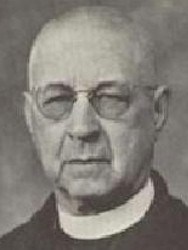
Joseph G. Esser was one of eight children of Frank Esser, a former composing room foreman for the “Wisconsin State Journal.” He attended Saint Francis Seminary in Milwaukee, Wisconsin, and transferred to Saint Paul Seminary in Saint Paul, Minnesota. He was ordained a Catholic priest in 1927, and spent the next 14 years in a number of parishes scattered throughout Minnesota. He enlisted in the Army on December 8, 1941, the day after the Japanese attack on Pearl Harbor, and attended the Chaplain’s School at Harvard before shipping out to Europe. He was wounded three times during the war, and after losing his thumb and forefinger of his right hand, was granted a special dispensation from the Pope to offer communion with his left hand. In the action that earned him the Silver Star, he was joined by two other ministers: Edgar Stohler and James M. Hamilton, in rescuing wounded for three hours. Following the war, he returned to the Midwest to minister, but re-enlisted for service in the Korean War.

Sponsored by:

–
Born:
,
Home:
,
Buried:
,
Cemetery:
Awards Received
-

Silver Star
-
Silver Star
Service:
United States ArmyRank:
Captain (Chaplain’s Corps)Regiment:
358th Infantry RegimentDivision:
90th Infantry DivisionAction Date:
July 23, 1944
Headquarters, 90th Infantry Division, General Orders No. 79 (October 19, 1944)The President of the United States of America, authorized by Act of Congress July 9, 1918, takes pleasure in presenting the Silver Star to Captain (Chaplain’s Corps) Joseph George Esser (ASN: 0-436238), United States Army, for gallantry in action against an armed enemy while serving as a chaplain with an Infantry Battalion of the 358th Infantry Regiment, 90th Infantry Division, in the vicinity of Seves, France, on 23 July 1944. His battalion was ordered to take the Island of Seves on 23 July. The attack jumped off as scheduled, but was met with withering mortar, artillery, and small arms fire. The casualties were so heavy that the battalion became disorganized, and the objective was not reached in strength enough to capture it and hold it. During the attack on an island, intense enemy mortar, artillery, and small arms fire resulted in many casualties. In the flat space on the approach to the island all casualties could not be reached, due to heavy machine gun and small arms fire, and the battalion was at a loss as to how to retrieve the wounded. Chaplain Esser volunteered to attempt to contact the enemy for a short cessation of fire, during which time he would be able to rescue the wounded. He, with Chaplain Edgar Stohler, walked straight into the German positions, completely disregarding the danger, in spite of the fact that he had been cautioned that it was practically a suicide mission. He was received by a German officer and arrangements were made to evacuate the American wounded. This took place only a few minutes before a scheduled bombing mission went into action over the spot where the Chaplain was negotiating with the German officer, an attack Chaplain Esser was aware was planned. On his return, after the wounded had been evacuated, he was strafed by our own planes. His gallantry inspired all who witnessed it and was in accordance with high military tradition.