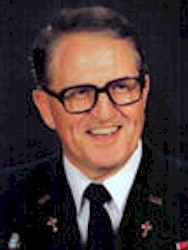
Conrad Walker was scouted to play baseball before he attended the University of Washington in Seattle, where he played guard on the Huskies football team and held amateur heavyweight boxing titles in the 1950s. After graduation he was offered a contract to football for the Green Bay Packers, but opted instead for a life of ministry, and attended Luther Seminary in St. Paul, Minnesota. Ordained a Lutheran minister, he pastored a parish in Elmore, Minnesota, before entering military service to be commissioned as a U.S. Army chaplain. Jump qualified, he was nicknamed “The Leapin’ Deacon,” making more than 600 jumps. In Vietnam he jumped with the 173d Airborne Brigade in the only major combat jump of the war. In 1967 he was named “Chaplain of the Year” by the Episcopal Church, because of his ministry to a mortally wounded soldier who was the son of an Episcopalian chaplain. After retiring from the Army as a colonel in 1990, he spent several years as pastor of MacArthur Park Lutheran Church, before continuing to serve the troops through the Worldwide Retreat Ministry.

Sponsored by:

–
Born:
,
Home:
,
Buried:
,
Cemetery:
Awards Received
-

Silver Star
-
Silver Star
Service:
United States ArmyRank:
Major (Chaplain’s Corps), [then Captain]Batallion:
2d BattalionRegiment:
503d Infantry Regiment, 173d Airborne Brigade (Separate)Action Date:
June 29, 1966
General Orders No. 584 (February 7, 1967)The President of the United States of America, authorized by Act of Congress July 9, 1918 (amended by an act of July 25, 1963), takes pleasure in presenting the Silver Star to Major (Chaplain’s Corps), [then Captain] Conrad Norman Walker, United States Army, for gallantry in action against the enemy while serving as a Chaplain with the 2d Battalion, 503d Infantry Regiment, 173d Airborne Brigade (Separate), in connection with operations against a hostile force in the Republic of Vietnam. Major Walker distinguished himself by exceptionally valorous actions on 29 June 1966, while serving as chaplain with a unit engaged with a large Viet Cong force near Xuan Loc. Chaplain Walker accompanied a relief platoon to the site of a vicious firefight where many men were dying or wounded. He ignored the hostile rounds striking all around him, to bring spiritual aid to the casualties. He also helped the medic to bring the wounded men back from the direct line of fire, despite the machine gun fire, which intermittently raked the area. When the Viet Cong were driven from the crucial positions, Chaplain Walker further exposed himself to incoming fire to prepare a landing zone for evacuation helicopters. He tied ropes onto the trees being chopped down and stood in vulnerable places, to pull the trees away from the wounded, as they fell. Without a thought of his own safety, he then carried the wounded men to the aircraft. Throughout the firefight, Chaplain Walker gave no heed to the unexploded, but highly dangerous grenades littering the zone, or the deadly sniper fire. The gallant actions and dedicated devotion to duty demonstrated by Chaplain Walker, without regard for his own life, were in keeping with the highest traditions of military service and reflect great credit upon himself and the United States Army.