General Douglas MacArthur personally decorated Lieutenant Anderson for this action. Two days later Anderson engaged a large number of enemy planes and shot down TWO before his own airplane was crippled and he was forced to bail out. General MacArthur subsequently reported, “Two Japanese planes followed him to the ground. His parachute was riddled with machine gun bullets and, while hanging helplessly in the air, he was shot to death. Still not satisfied, one enemy plane returned to dive and machine gun the crumpled body.” In all he was credited with shooting down a total of 2 enemy aircraft.

Sponsored by:

Marshall
Judson
Anderson
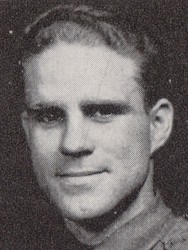
MIA (WWII) KIA
June 1, 1915
–
January 19, 1942
Cemetery:
A.B.M.C. Manila (Wall of Missing)
Awards Received
-

Distinguished Service Cross
-
Distinguished Service Cross
Service:
United States Army Air ForcesRank:
First Lieutenant (Air Corps)Batallion:
20th Pursuit SquadronRegiment:
24th Pursuit GroupDivision:
Far East Air ForceAction Date:
January 17, 1942
Headquarters, U.S. Army Forces in the Far East, General Orders No. 12 (January 21, 1942)The President of the United States of America, authorized by Act of Congress July 9, 1918, takes pride in presenting the Distinguished Service Cross (Posthumously) to First Lieutenant (Air Corps) Marshall Judson Anderson (ASN: 0-396368), United States Army Air Forces, for extraordinary heroism in connection with military operations against an armed enemy while serving as Pilot of a P-40 Fighter Airplane in the 20th Pursuit Squadron, 24th Pursuit Group, FAR EAST Air Force, in action on Bataan Peninsula, Philippine Islands, on 17 January 1942. Ordered to lead his flight of pursuit airplanes in a dawn reconnaissance of front line areas with the secondary mission of destroying enemy installations and aircraft, Lieutenant Anderson took off at the head of his flight directly into the face of enemy dive-bombers which were hovering over the flying field. The hostile airplanes were dispersed. Upon gaining additional altitude, he attacked and shot down an enemy observation plane within sight of an approaching Japanese bomber formation. He then led his flight in an attack on the hostile bomber formation, forcing the bombers to release their bombs prematurely and harmlessly, and to disperse. Observing an enemy truck convoy, Lieutenant Anderson continued the execution of his mission by leading his flight in a heavy strafing attack of the convoy. Although ammunition and fuel were now nearly exhausted, he led his flight in a successful attack on a second hostile observation plane, after which he brought his flight safely to its base. In the same vicinity two days later, Lieutenant Anderson’s flight was attacked by a superior force of enemy aircraft. He gave battle immediately, shooting down one of the hostile airplanes before he was brought down to his death in a hail of enemy fire. Lieutenant Anderson’s unquestionable valor in aerial combat is in keeping with the highest traditions of the military service and reflects great credit upon himself and the United States Army Air Forces.