On the day before the Battle for Nam Dong that earned John Houston the Distinguished Service Cross and his Commander Captain Roger Donlon the FIRST Medal of Honor of the Vietnam War, the young sergeant received a letter from home informing him that his wife was about to give birth to twins. One of them, John L. Houston, Jr., died at birth and is buried with his father at Arlington Cemetery. The wife of Gabriel Alamo, the other posthumous DSC recipient from that battle, was the only other spouse of a team member pregnant at the time of the battle. Upon learning of her husband’s death, she miscarried adding to the tragedy.

Sponsored by:

John
Lucius
Houston
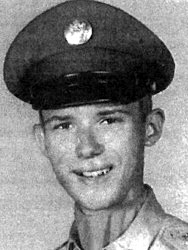
KIA (RVN)
November 6, 1941
–
November 6, 1941
Cemetery:
Arlington National Cemetery
Awards Received
-

Distinguished Service Cross
-
Distinguished Service Cross
Service:
United States ArmyRank:
SergeantRegiment:
7th Special Forces Group (Airborne)Division:
1st Special ForcesAction Date:
July 6, 1964
Department of the Army, General Orders No. 8 (March 9, 1965)The President of the United States of America, authorized by Act of Congress, July 9, 1918 (amended by act of July 25, 1963), takes pride in presenting the Distinguished Service Cross (Posthumously) to Sergeant John Lucius Houston (ASN: 14706416), United States Army, for extraordinary heroism in connection with military operations involving conflict with an armed hostile force in the Republic of Vietnam, while serving with Detachment A-726, 7th Special Forces Group (Airborne), 1st Special Forces. Sergeant Houston distinguished himself by exceptionally valorous actions on 6 July 1964 as a Radio Operator, serving with the United States Army Special Forces Detachment A-726 at Camp Nam Dong, Sergeant Houston demonstrated fortitude, courage, and determination when a reinforced Viet Cong battalion suddenly launched a full-scale, predawn attack on the camp. During the violent battle that ensued, lasting five hours and resulting in heavy casualties on both sides, he participated with outstanding effectiveness in defending the installation. As he was moving to his battle position, he noticed that one of his team members had been knocked down by an exploding mortar. With complete disregard for his own personal safety, he rushed through a hail of small arms fire and exploding mortars, succeeded in reaching the unconscious soldier, placed him in a covered position, and stayed with him until fully recovered before proceeding to his battle station. After he had moved only a few yards and was slightly injured by an exploding mortar, Sergeant Houston pressed on toward a large mound of dirt which afforded him excellent observation and fields of fire. From this position, he single-handedly shattered the vicious enemy assault in his sector and annihilated many of the enemy troops. As the hostile forces retaliated with an intense grenade assault on his position, he again deterred the enemy action. Although his ammunition was running out, he refused to take cover, called out to a fellow soldier to throw additional rounds to him, and reloaded the magazine while exposed to the heavy enemy gunfire. Undaunted by the overwhelming onslaught, he remained in this dangerous position for over two hours to defend the camp and displayed his valiant efforts until mortally wounded by the enemy. Sergeant Houston’s extraordinary heroism and devotion to duty, at the cost of his life, were in keeping with the highest traditions of the military service and reflect great credit upon himself, his unit, and the United States Army.