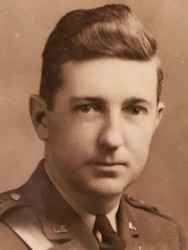
Robert Hearn began preparing for the priesthood at age 14. He graduated from the Church of our Lady of Perpetual Help Parochial School and High School in Roxbury, Massachusetts. He then entered the Redemptorist Preparatory College in Pennsylvania. During his summer vacations he played semiprofessional baseball. In 1924 he began a year of introspection and prayer at a Redemptorist novitiate in Ilchester Maryland, and from 1925 to 1930 he continued studies at Esopus, New York. On June 29, 1930, he was ordained a Redemptorist (Catholic) priest and said his first Mass at the Mission Church in his old neighborhood. He worked as a priest in Pennsylvania and as a missionary in Brazil before becoming a civilian chaplain in 1940. The following year he applied for an Army commission in order to minister to front-line troops. After jungle training in Panama, he joined the 158th Regimental Combat Team in combat in New Guinea, and in 1944 transferred to the 1st Infantry Regiment of the 6th Infantry Division, serving in the New Guinea and Philippine Islands campaigns. He stayed in service after the war and was assigned to the 24th Infantry Division, entering combat again in Korea in 1950, serving there until 1951. In 1957 he retired as a U.S. Army colonel.

Sponsored by:

–
Born:
,
Home:
,
Buried:
,
Cemetery:
Awards Received
-

Silver Star
-
Silver Star
Service:
United States ArmyRank:
First Lieutenant (Chaplain’s Corps)Regiment:
158th Regimental Combat Team (Separate)Division:
41st Infantry Division (Attached)Action Date:
March 2, 1945
(Citation Needed) – SYNOPSIS: The President of the United States of America, authorized by Act of Congress July 9, 1918, takes pleasure in presenting the Silver Star to First Lieutenant (Chaplain’s Corps) Robert J. Hearn (ASN: 0-51131), United States Army, for gallantry in action against the enemy while serving as a Chaplain with the 158th Regimental Combat Team (Separate), attached to the 41st Infantry Division; and then with the 1st Infantry Regiment, in New Guinea and the Philippine Islands, in February and March 1945. On one occasion in February, Chaplain Hearn was wounded in the leg while carrying wounded soldiers to safety. Days later in 2 March 1945, he was conducting mass in a abandoned house when the Japanese sprayed the room with machinegun fire and rushed the house. Chaplain Hearn and two other men spent six hours hiding in a closet while the Japanese searched the house. The gallant actions and dedicated devotion to duty demonstrated by Chaplain Hearn, without regard for his own life, were in keeping with the highest traditions of military service and reflect great credit upon himself and the United States Army.