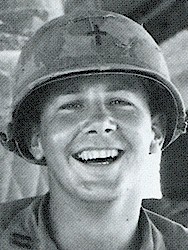
Jerry Autry grew up in Dunn North Carolina, the youngest of five boys, four of whom served in World War II or Korea. After graduating from school, he determined to become a minister, but military service was also in his plans. Ordained a Congregationalist minister, newly married, and just out of seminary, he enlisted for military service and was commissioned a U.S. Army chaplain. After airborne training, he was deployed to Vietnam where he was a highly-decorated chaplain in the 101st Airborne Division. Following his combat tour he remained in service with postings in Germany, Korea, and many stateside posts, and retired as a colonel after 29 years of military service and ministry. He then pastored the Congregational Church in Rio Vista, California, for eight years.

Sponsored by:

–
Born:
,
Home:
,
Awards Received
-
Silver Star
-
Silver Star
Service:
United States ArmyRank:
Captain (Chaplain’s Corps)Batallion:
1st BattalionRegiment:
501st Infantry RegimentDivision:
101st Airborne DivisionAction Date:
Vietnam War
(Citation Needed) – SYNOPSIS: The President of the United States of America, authorized by Act of Congress July 9, 1918, takes pleasure in presenting the Silver Star to Captain (Chaplain’s Corps) Jerry Davis Autry, United States Army, for gallantry in action involving close combat against an armed hostile force in the Republic of Vietnam. Chaplain Autry distinguished himself by exceptionally valorous actions in 1968, while serving as Chaplain of the 1st Battalion, 501st Infantry Regiment, 101st Airborne Division, on a combat mission near Hue, in the Republic of Vietnam, in 1968. Finding himself in the middle of a well-concealed mine field, at the detonation of the first mine the paratroopers froze. Immediately the Viet Cong began firing at the exposed men, causing more mines to explode. Chaplain Autry was wounded in the furious melee of flying bullets and mine fragments. The rest f the company pulled back and laid down a wall of supporting fire, as other units maneuvered to silence the enemy. Chaplain Autry, however, was not content to sit and wait it out. Disregarding his own wound, he dragged one wounded soldier through the mines to safety, and then went back for another. When the enemy was finally silenced, Chaplain Autry was on his way back to recover yet a third wounded man. Chaplain Autry’s extraordinary heroism in close combat against an enemy force is in keeping with the highest traditions of the military service and reflect great credit upon himself, the 101st Airborne Division, and the United States Army.