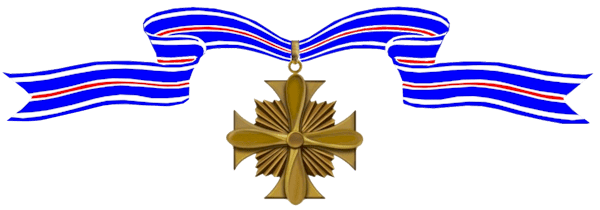
The President of the United States of America takes pleasure in presenting the Distinguished Flying Cross to Captain Ken H. Johnson (MCSN: 0-84925), United States Marine Corps, for heroism and extraordinary achievement while participating in aerial flight while serving as a Pilot with Marine Observation Squadron TWO (VMO-2), Marine Aircraft Group Sixteen, FIRST Marine Aircraft Wing in connection with combat operations against the enemy in the Republic of Vietnam. On 17 August 1969, Captain Johnson launched as Tactical Air Controller (Airborne) aboard an OV-10 Bronco aircraft assigned the mission of supporting the emergency re-supply of a Marine reconnaissance team which was heavily engaged in combat with a hostile force while manning an observation post on Ba Na Mountain in Quang Nam Province. Two previous attempts to deliver ammunition and other supplies had been aborted because of the intensity of the hostile fire. Arriving over the designated area, Captain Johnson found that the ceiling over the landing zone was 200 feet and continuing to lower and that the beleaguered team was pinned down by the heavy volume of enemy fire. When F-4 Phantom aircraft arrived on station, he briefed the pilots concerning the ground situation and directed them to execute two low-altitude simulated firing passes to assure proper target identification because of the proximity of the opposing units. Undaunted by the shifting clouds and low ceiling which forced him to mark the target prior to each air strike and the extremely intense hostile fire directed at his Bronco during each marking run, Captain Johnson skillfully coordinated and controlled the repeated bombing runs with such precision that all of the ordnance was delivered upon the target with pinpoint accuracy. As a result of the devastating attacks, the enemy fire was suppressed sufficiently to enable the transport aircraft to enter the precarious zone and deliver the vitally needed supplies. Captain Johnson’s courage, superior airmanship, and unwavering devotion to duty in the face of great personal danger were instrumental in the accomplishment of the hazardous mission and were in keeping with the highest traditions of the Marine Corps and of the United States Naval Service.

Sponsored by:

Awards Received
-
Silver Star
-
Silver Star
Service:
United States Marine CorpsRank:
CaptainBatallion:
Marine Observation Squadron 2 (VMO-2)Division:
1st Marine Aircraft WingAction Date:
April 21, 1969
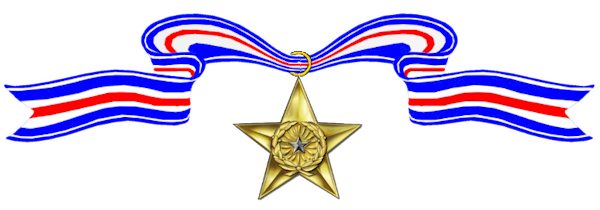
The President of the United States of America takes pleasure in presenting the Silver Star to Captain Ken H. Johnson (MCSN: 0-84925), United States Marine Corps, for conspicuous gallantry and intrepidity in action while serving as a Pilot with Marine Observation Squadron TWO (VMO-2), Marine Aircraft Group Sixteen, FIRST Marine Aircraft Wing, in connection with combat operations against the enemy in the Republic of Vietnam. On 21 April 1969, Captain Johnson launched as Copilot/Gunner of an AH1G Cobra aircraft assigned a support mission for the emergency medical extraction of seriously wounded men of a Marine unit which was heavily engaged with a large hostile force northeast of Liberty Bridge in Quang Nam Province. Arriving over the designated location, he learned that previous rescue attempts had been unsuccessful due to the heavy machine gun fire, which had extensively damaged one helicopter and forced the pilot of a second CH-46 transport to abort an extraction attempt. As the pilot of the second evacuation helicopter commenced a rapid approach to the landing zone, the aircraft came under a heavy volume of enemy fire. Skillfully pinpointing hostile targets and pointing them out to the pilot, Captain Johnson, with complete disregard for his own safety, repeatedly attacked the enemy positions with rockets and machine gun fire and thereby enabled the helicopter to accomplish its mission, although both aircraft were damaged by enemy fire. During two subsequent missions on the same day, Captain Johnson disregarded his own safety as he calmly pointed out enemy machine gun positions manned by determined enemy soldiers, successfully assisting the evacuation of critically injured men. His heroism and determined devotion to duty inspired all who observed him and were instrumental in saving several injured Marines. By his courage, aggressive fighting spirit, and unswerving devotion to duty in the face of grave personal danger, Captain Johnson contributed significantly to the completion of the vital mission and upheld the highest traditions of the Marine Corps and of the United States Naval Service.