During the 17-hour engagement called the “Battle of Robert’s Ridge,” two Airmen were posthumously awarded the Air Force Cross, and Christopher Russell was one of EIGHT Airmen awarded the Silver Star, including pilot of his TWISTER 52, Kirk Rieckhoff. The battle was so-named because it followed an incident in which Navy Seal Neil Roberts fell from a helicopter as it attempted to land on a mountaintop controlled by al Qaeda fighters, initiating an intense and heroic rescue effort.

Sponsored by:

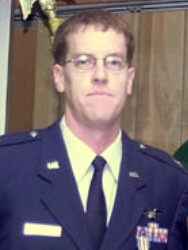
Christopher
J.
Russell
Awards Received
-
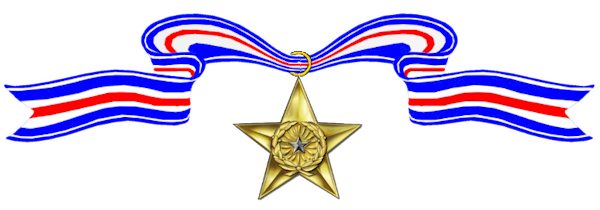
Silver Star
-
Silver Star
Service:
United States Air ForceRank:
CaptainBatallion:
335th Fighter Squadron (TWISTER 52)Action Date:
March 4, 2002
The President of the United States of America, authorized by Act of Congress July 9, 1918 (amended by an act of July 25, 1963), takes pleasure in presenting the Silver Star to Captain Christopher J. Russell, United States Air Force, for conspicuous gallantry and intrepidity in action while serving as Weapons Systems Operator of an F-15E Strike Eagle of the 335th Fighter Squadron, in support of Operation ENDURING FREEDOM, on an air mission during Operation ANACONDA at Shahi Kot Valley, Afghanistan on 4 March 2002. On that date, flying as TWISTER 52, Captain Russell’s flight contacted an American ground forward air controlling team who reported they were taking fire from enemy troops seventy-five meters away. The ground team restricted TWISTER flight to strafe passes only due to a “Danger Close” condition–friendly troops within minimum risk distances of injury or death from friendly weapons expenditures on enemy locations. Target recognition and delivery accuracy were imperative. TWISTER flight, without regard for their own safety, made a total of six strafe passes with high explosive incendiary rounds at an altitude of 1,500 feet over the target. This was well within the threat envelope of small arms fire and surface-to-air missiles. The ground team reported enemy fire was suppressed on each pass but requested more passes to kill steadily increasing numbers of reinforced Taliban and al Qaeda forces. Out of high explosive incendiary ammunition, TWISTER 51 became the airborne forward air controller and targeted TWISTER 52 on four additional low-altitude strafe passes. Due to a ultra high frequency radio failure, TWISTER 51 then passed the tactical lead to Captain Russell’s aircraft. With the ground team’s concurrence, TWISTER flight began employing their laser-guided bombs. TWISTER flight attempted to walk each of their successive bombs closer to enemy forces without injuring United States personnel. TWISTER 52’s first pass was placed four hundred meters away from the ground team’s location. TWISTER 51 followed that with one placed two hundred meters away. TWISTER flight remained on-station for over five hours, two hours past their scheduled coverage time. This resulted in a 12.3-hour combat sortie, which included three night and five day aerial refuelings per aircraft. By inflicting direct losses to al Queda and Taliban forces located seventy-five meters from friendly positions while subjecting himself to enemy fire, Captain Russell’s aviation prowess was responsible for the eventual rescue of twenty-three American personnel and the advancement of the United States’ war on terrorism. By his gallantry and devotion to duty, Captain Russell has reflected great credit upon himself and the United States Air Force.