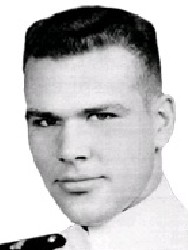
Joseph Crowe graduated from the U.S. Coast Guard Academy, New London, Connecticut, Class of 1962. He retired as a U.S. Coast Guard Captain.

Sponsored by:

Joseph
L.
Crowe
, Jr.
Awards Received
-

Distinguished Flying Cross
-
Distinguished Flying Cross
-
Distinguished Flying Cross
-
Distinguished Flying Cross
Service:
United States Coast GuardRank:
Lieutenant CommanderBatallion:
37th Aerospace Rescue & Recovery Squadron (Attached)Action Date:
September 26, 1971
The President of the United States of America takes pleasure in presenting the Distinguished Flying Cross (Air Force Award) to Lieutenant Commander Joseph L. Crowe, Jr., United States Coast Guard, for extraordinary achievement while participating in aerial flight as an Aircraft Commander on an HH-53c Rescue Helicopter, attached to the 37th Aerospace Rescue and Recovery Squadron, United States Air Force, in action at Kampong Cham, Cambodia, on 26 September 1971. On that date, Commander Crowe’s outstanding airmanship, exemplary leadership and sound technical skill resulted in the successful rescue of two aircrew members who had been downed by hostile fire. Commander Crowe, knowing that hostile locations were within two miles, executed a spiraling descent to a landing, keeping his helicopter over friendly territory at all times. The professional competence, aerial skill, and devotion to duty displayed by Commander Crowe reflect great credit upon himself and the United States Air Force.
-
Distinguished Flying Cross
Service:
United States Coast GuardRank:
Lieutenant CommanderBatallion:
37th Aerospace Rescue & Recovery Squadron (Attached)Action Date:
April 3, 1972
The President of the United States of America takes pleasure in presenting a Bronze Oak Leaf Cluster in lieu of a Second Award of the Distinguished Flying Cross (Air Force Award) to Lieutenant Commander Joseph L. Crowe, Jr., United States Coast Guard, for extraordinary achievement while participating in aerial flight as Aircraft Commander, HH-53 Helicopter, attached to the 37th Aerospace Rescue and Recovery Squadron, United States Air Force, in action near Quang Tri City, Republic of Vietnam, on 3 April 1972. On that date, Commander Crowe led a flight of two HH- 53 helicopters in an attempt to rescue the survivor of a United States aircraft downed in the area. With total disregard for his own safety, Commander Crowe flew his aircraft into intense enemy fire in an attempt to execute the rescue. Although his aircraft suffered severe battle damage, Commander Crowe demonstrated professional skill of the highest order and saved his crew and a valuable rescue helicopter. The professional competence, aerial skill, and devotion to duty displayed by Commander Crowe reflect great credit upon himself and the United States Coast Guard.
-
Distinguished Flying Cross
Service:
United States Coast GuardRank:
Lieutenant CommanderAction Date:
April 4, 1975
The President of the United States of America takes pleasure in presenting a Gold Star in addition to a previously awarded Bronze Oak Leaf Cluster in lieu of a Third Award of the Distinguished Flying Cross to Lieutenant Commander Joseph L. Crowe, Jr., United States Coast Guard, for extraordinary achievement while participating in aerial flight on the morning of 4 April, 1975 while serving as aircraft commander of Coast Guard HH-3F helicopter engaged in the perilous rescue of eight crewmen from the Liberian tanker SPARTAN LADY which had broken in half in raging seas and hurricane force winds approximately 145 miles south of Cape Cod, Massachusetts. Dispatched from Coast Guard Air Station, Cape Cod in a blinding snowstorm, Lieutenant Commander Crowe skillfully piloted the helicopter to the stricken vessel, whose bow and stern sections had drifted about two miles apart in the 20 to 30 Ð foot seas and was directed to evacuate eight stranded crewmen from the bow section. Despite 60-knot winds and limited visibility, Lieutenant Commander Crowe expertly maneuvered the helicopter over the stricken vessel and after repeated attempts, improvised a method of getting the trail line to the bow section which was pitching and rolling violently in the mountainous seas. He then established a hover altitude in excess of 100 feet over the severely inclined deck of the bow and maintained this position for 45 minutes, avoiding the wildly swinging 100-foot mast, until all survivors were hoisted to safety. Upon completion of the arduous hoist operation, Lieutenant Commander Crowe immediately departed the area due to a low fuel state and encountered further deteriorating weather conditions as he approached his destination. With no suitable alternatives, he skillfully and precisely executed an approach to a runway with the lowest authorized descent altitude despite a 50-degree gusty crosswind; safely landed the helicopter; deplaned the survivors to waiting ambulances. Lieutenant Commander Crowe’s innovative actions, expert aeronautical skills, and dauntless valor throughout this perilous mission resulted in saving the lives of eight crewmen. His heroic courage, sound judgment, and unwavering devotion to duty are in keeping with the highest traditions of the United States Coast Guard.