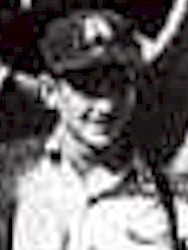
During World War II, Sammy Pierce became a U.S. Army Air Forces ACE, credited with shooting down 7 enemy aircraft in aerial combat. After the war he transferred to the new U.S. Air Force, and retired in 1963 as a Lieutenant Colonel.

Sponsored by:

Sammy
Alpheus
Pierce
August 25, 1921
–
January 9, 2010
Born:
Ayden
,
North Carolina
Home:
Ayden
,
North Carolina
Buried:
Ayden
,
North Carolina
Cemetery:
Ayden Cemetery
Awards Received
-
Silver Star
-
Distinguished Flying Cross
-
Distinguished Service Cross
-
Silver Star
Service:
United States Army Air ForcesRank:
Flight OfficerBatallion:
8th Fighter SquadronRegiment:
49th Fighter GroupDivision:
5th Air ForceAction Date:
May 14, 1943
Headquarters, 5th Air Force, General Orders No. 166 (July 29, 1943)The President of the United States of America, authorized by Act of Congress July 9, 1918, takes pleasure in presenting the Silver Star to Flight Officer Sammy Alpheus Pierce (ASN: 0-888656/T00190601), United States Army Air Forces, for gallantry in action against the enemy while serving as Pilot of a P-38 Lightning Fighter Airplane of the 8th Fighter Squadron, 49th Fighter Group, FIFTH Air Force, in aerial operations over the Oro Bay Area, New Guinea, on 14 May 1943. The gallant actions and dedicated devotion to duty demonstrated by Flight Officer Pierce, without regard for his own life, were in keeping with the highest traditions of military service and reflect great credit upon himself and the United States Army Air Forces.
-
Distinguished Flying Cross
Service:
United States Army Air ForcesRank:
First Lieutenant (Air Corps)Batallion:
8th Fighter SquadronRegiment:
49th Fighter GroupDivision:
5th Air ForceAction Date:
May 17 – September 4, 1943
Headquarters, 5th Air Force, General Orders No. 219 (October 5, 1943)The President of the United States of America, authorized by Act of Congress, July 2, 1926, takes pleasure in presenting the Distinguished Flying Cross to First Lieutenant (Air Corps) Sammy Alpmeus Pierce (ASN: 0-888656/T00190601), United States Army Air Forces, for extraordinary achievement while participating in fifty operational flight missions from 17 May 1943 to 4 September 1943, while serving as a P-38 Fighter Pilot of the 8th Fighter Squadron, 49th Fighter Group, FIFTH Air Force. These operations included escorting bombers and transport aircraft, interception and attack missions, and patrol and reconnaissance flights. In the course of these operations, strafing and bombing attacks were made from dangerously low altitudes, destroying and damaging enemy installations and equipment. Throughout these flights outstanding courage, ability and devotion to duty were demonstrated. His devotion to duty and courage under all conditions serve as an inspiration to his fellow flyers. His actions reflect the highest credit upon himself and the Armed Forces of the United States.
-
Distinguished Service Cross
Service:
United States Army Air ForcesRank:
First Lieutenant (Air Corps)Batallion:
8th Fighter SquadronRegiment:
49th Fighter GroupDivision:
5th Air ForceAction Date:
December 26, 1944
Headquarters, U.S. Forces-Pacific, General Orders No. 51 (July 15, 1945)The President of the United States of America, authorized by Act of Congress July 9, 1918, takes pleasure in presenting the Distinguished Service Cross to First Lieutenant (Air Corps) Sammy Alpheus Pierce (ASN: 0-888656/T00190601), United States Army Air Forces, for gallantry in action while serving as Pilot of a P-38 Fighter Airplane in the 8th Fighter Squadron, 49th Fighter Group, FIFTH Air Force, in action over Clark Field, Philippine Islands, on 26 December 1944. While flying one of a flight of five fighter planes escorting heavy bombers over Clark Field, Lieutenant Pierce sighted three enemy fighters coming in for an attack on the lead fighters. Making a head-on pass, he fired a burst into one of the enemy planes, causing it to explode at such close range that his own plane was damaged by the blast. As the remaining two planes dispersed, he attacked a second formation of four enemy planes, shot one down in flames, and caused the formation to scatter. Next, observing a third enemy formation of five planes, he attacked the lead plane with bursts from high astern, destroyed it, and split the formation. Then sighting a lone enemy fighter, he attacked the plane in a high pass and with a single long burst shot it to the ground. Lieutenant Pierce, by breaking up three enemy formations and destroying four enemy planes, enabled the escorted bombers to continue on their mission against the enemy.