Gene Hawthorne was a full-blooded Navajo Indian from Arizona. On April 1966, months after the action for which he received the DSC, he was evacuated for jungle rot on his right foot; an evacuation he resisted. While being treated he repeatedly requested to return to his unit. When medics finally consented, on May 4, 1966, he limped to a helicopter to leave the aid facility and return. In the darkness of that night the helicopter crashed in a ball of flame, and he was killed.

Sponsored by:

Gene
Hawthorne
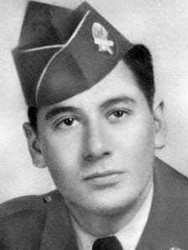
DNB (1966)
September 27, 1933
–
May 4, 1966
Born:
Shadow Rock
,
Arizona
Home:
Lupton
,
Arizona
Buried:
Santa Fe
,
New Mexico
Cemetery:
Santa Fe National Cemetery
Awards Received
-

Distinguished Service Cross
-
Distinguished Service Cross
Service:
United States ArmyRank:
SergeantBatallion:
2d Battalion (Airborne)Regiment:
502d Infantry RegimentDivision:
101st Airborne DivisionAction Date:
December 9 – 10, 1965
Headquarters, United States Army, Pacific, General Orders No. 159 (July 14, 1966)The President of the United States of America, authorized by Act of Congress July 9, 1918, takes pride in presenting the Distinguished Service Cross (Posthumously) to Sergeant Gene Hawthorne (ASN: RA-18403068), United States Army, for extraordinary heroism in connection with military operations against an armed hostile force in the Republic of Vietnam. Sergeant Hawthorne, a member of Company A, 2d Battalion (Airborne), 502d Infantry Regiment, 101st Airborne Division. On December 9 – 10, he infiltrated his patrol into hostile territory to observe insurgent activity and prepare for the advance of friendly forces. Despite the skill and experience of the patrol, they were discovered after many hours in unfriendly territory and subsequently engaged by a numerically superior insurgent force. Sergeant Hawthorne reacted to the situation by having his patrol rush the insurgents. After losing 7 or 8 men, the Viet Cong withdrew. Sergeant Hawthorne immediately began moving his patrol to a more favorable position in the event the Viet Cong attacked again. During the move, Sergeant Hawthorne was wounded in both arms by a booby-trop that took the life of one of his men. Rather than burden his patrol he courageously asked that he be left behind. His assistant refused to leave him, so Sergeant Hawthorne directed the formation of a defensive perimeter. Though painfully wounded, and barely conscious, he insisted that he be placed in a firing position to assist his comrades. During the ensuing assaults he poured fire into the insurgent ranks. Utilizing his strength, he pointed out the patrol’s position for the artillery battery and helped adjust the incoming rounds by the sound of the bursts. At this point, the insurgents broke contact. Sergeant Hawthorne’s extraordinary heroism and gallantry in action are in keeping with the highest traditions of the military service and reflect great credit upon himself, his unit, and the United States Army.