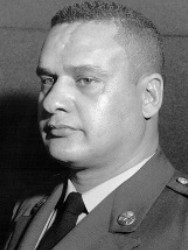
Webster Anderson was severely wounded in the action that earned him the Medal of Honor, and was evacuated promptly by helicopter in efforts to save his life. The pilot of the medical evacuation helicopter (MEDEVAC) that flew him out to the hospital was Patrick Brady, who would later earn the Medal of Honor for heroic actions in evacuating other wounded in a different action.

Sponsored by:

Webster
Anderson
July 15, 1933
–
August 30, 2003
Cemetery:
Blackjack Baptist Church Cemetery
Awards Received
-

Medal of Honor
-
Medal of Honor
Service:
United States ArmyRank:
Sergeant First ClassBatallion:
2d BattalionRegiment:
320th Artillery RegimentDivision:
101st Airborne Division (Airmobile)Action Date:
October 15, 1967
Department of the Army, General Orders No. 80 (December 4, 1969)The President of the United States of America, in the name of Congress, takes pleasure in presenting the Medal of Honor to Sergeant First Class Webster Anderson (ASN: RA-53202920), United States Army, for conspicuous gallantry and intrepidity at the risk of his life above and beyond the call of duty while serving with Battery A, 2d Battalion, 320th Artillery Regiment, 101st Airborne Division (Airmobile), in action against enemy aggressor forces at Tam Ky, Republic of Vietnam, on 15 October 1967. During the early morning hours Battery A’s defensive position was attacked by a determined North Vietnamese Army infantry unit supported by heavy mortar, recoilless rifle, rocket propelled grenade and automatic weapon fire. The initial enemy onslaught breached the battery defensive perimeter. Sergeant First Class Anderson, with complete disregard for his personal safety, mounted the exposed parapet of his howitzer position and became the mainstay of the defense of the battery position. Sergeant First Class Anderson directed devastating direct howitzer fire on the assaulting enemy while providing rifle and grenade defensive fire against enemy soldiers attempting to overrun his gun section position. While protecting his crew and directing their fire against the enemy from his exposed position, two enemy grenades exploded at his feet knocking him down and severely wounding him in the legs. Despite the excruciating pain and though not able to stand, Sergeant First Class Anderson valorously propped himself on the parapet and continued to direct howitzer fire upon the closing enemy and to encourage his men to fight on. Seeing an enemy grenade land within the gun pit near a wounded member of his gun crew, Sergeant First Class Anderson heedless of his own safety, seized the grenade and attempted to throw it over the parapet to save his men. As the grenade was thrown from the position it exploded and Sergeant First Class Anderson was again grievously wounded. Although only partially conscious and severely wounded, Sergeant First Class Anderson refused medical evacuation and continued to encourage his men in the defense of the position. Sergeant First Class Anderson by his inspirational leadership, professionalism, devotion to duty and complete disregard for his welfare was able to maintain the defense of his section position and to defeat a determined attack. Sergeant First Class Anderson’s gallantry and extraordinary heroism at the risk of his life above and beyond the call of duty are in the highest traditions of the military service and reflect great credit upon himself, his unit, and the United States Army.