James Reedy graduated from the U.S. Naval Academy at Annapolis, Class of 1923. He retired as a U.S. Navy Rear Admiral.

Sponsored by:

James
Robert
Reedy

Awards Received
-
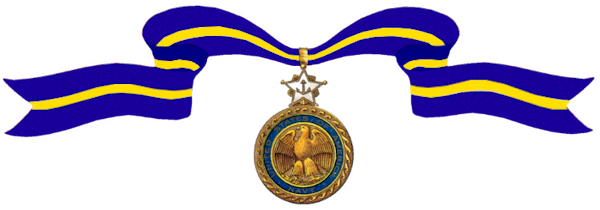
Navy Distinguished Service Medal
-

Legion of Merit
-
Navy Distinguished Service Medal
Service:
United States NavyRank:
Rear AdmiralAction Date:
July 23, 1965 – April 30, 1966
All Hands (April 1967)The President of the United States of America takes pleasure in presenting the Navy Distinguished Service Medal to Rear Admiral James Robert Reedy, United States Navy, for exceptionally meritorious and distinguished service in a position of great responsibility to the Government of the United States as Commander Attack Carrier Striking Force, U.S. SEVENTH Fleet, from 23 July 1965 through 30 April 1966. Rear Admiral Reedy directly supervised the formulation of procedures designed to employ most effectively the three carrier division staffs and five attack carrier striking groups under his command in combat operations in Southeast Asia. He was instrumental in establishing a Yankee Team Commander and Yankee Team Surface-Subsurface Surveillance Coordinator; publishing continuously updated Yankee Team Standard Operating Procedures; developing Southeast Asia Electronics Warfare Doctrine; promulgating a combat tactics handbook; establishing a highly effective Tonkin Gulf SAR (Search and Rescue) Team with around-the-clock helicopter rescue capability; forming the Joint Task Force 77/Seventh Air Force Coordinating Committee; compiling a CTF 77 Missile Manual; and enhancing the effectiveness of new weapons and intelligence collection systems.
-
Legion of Merit
All Hands (August 1965)The President of the United States of America takes pleasure in presenting the Legion of Merit to Rear Admiral James Robert Reedy, United States Navy, for exceptionally meritorious conduct in the performance of outstanding services to the Government of the United States as Commander, U.S. Naval Support Forces, Antarctica, and U.S. Antarctic Projects Officer, from June 1963 to January 1965. Rear Admiral Reedy made a major contribution toward expanding the scope of this program through exploration and establishment of new stations to cover heretofore unknown areas of the Antarctic continent. New approaches to the continent were opened. In addition to making the first flights from Africa and Australia to Antarctica, he directed the first flight from South America across the Antarctic continent and led exploratory flights from McMurdo Station across the South Pole to unexplored areas of Queen Maud Land.