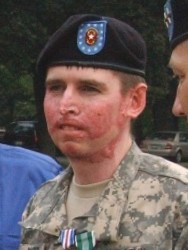
(Citation Needed) – SYNOPSIS: The President of the United States of America, authorized by Act of Congress July 9, 1918 (amended by an act of July 25, 1963), takes pleasure in presenting the Silver Star to Corporal Clinton A. Warrick, United States Army, for conspicuous gallantry and intrepidity in action while serving as a Combat Medic with the 2d Platoon, 300th Military Police Company, during combat operations in support of Operation IRAQI FREEDOM, on 18 September 2006, in Iraq. On that date U.S. military police and Iraqi policemen were conducting their usual transitional training at the Al Huria police station in Iraq. Suddenly, without warning, small-arms fire erupted from all directions. The base was under siege. Coalition forces concentrated fire on the attackers, but then a speeding pick-up truck crashed through the entrance and careened toward the center of the station. The truck detonated its 200-pound aircraft bomb, throwing Corporal Warrick several meters and knocking him unconscious. Rubble from the explosion buried him. Corporal Warrick’s platoon leader saw what happened and quickly pulled him from the debris. Corporal Warrick’s legs were on fire so the platoon leader used a fire extinguisher to put out the flames. When Corporal Warrick regained consciousness, he realized that he was badly burned but he also realized that if he sat in one place, he would go into shock. He requested morphine, but his medic bag was buried in the burning building. As a medic, he knew that without pain medication, his only choice to avoid slipping into shock was to stay active. So he climbed through a hole in the building to see how he could assist. With a heavy stream of fire still raining down on the station, and suffering from third-degree burns over 45 percent of his body as well as shrapnel wounds and smoke-inhalation injuries, Corporal Warrick went about the work of a medic: He assessed injured soldiers and Iraqi policemen and told the nearby support battalion what injuries they could expect. That vital information helped save the lives of seven Iraqi policemen. Corporal Warrick realized he couldn’t fight off the shock much longer, so he moved to the north side of the station where he could be evacuated to the medical station himself. Corporal Warrick’s gallant actions and dedicated devotion to duty, without regard for his own life, were in keeping with the highest traditions of military service and reflect great credit upon himself, his unit, and the United States Army.

Sponsored by:

Clinton
A.
Warrick
Awards Received
-

Silver Star
-
Silver Star