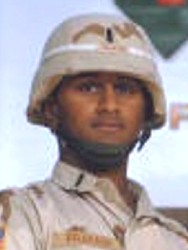
Although born in India and maintaining strong ties to the Indian community, Neil Prakash was raised in Syracuse, New York, in what he called a very patriotic American household. An ROTC cadet at Johns Hopkins University, he planned to follow in the footsteps of his mother, father and older brother – all doctors – and attend medical school. But after attending an ROTC Branch Orientation during his senior year, he chose instead to join the U.S. Army.

Sponsored by:

Neil
Prakash
Awards Received
-

Silver Star
-
Silver Star
Service:
United States ArmyRank:
First Lieutenant (Armor)Batallion:
2d BattalionRegiment:
63d Armored RegimentDivision:
1st Infantry DivisionAction Date:
June 24, 2004
(Citation Needed) – SYNOPSIS: The President of the United States of America, authorized by Act of Congress July 9, 1918 (amended by an act of July 25, 1963), takes pleasure in presenting the Silver Star to First Lieutenant (Armor) Neil Prakash, United States Army, for conspicuous gallantry and intrepidity in action while serving as a Platoon Leader with 2d Battalion, 63d Armored Regiment, 1st Infantry Division, during combat operations in support of Operation IRAQI FREEDOM, on 24 June 2004, in Iraq. On the morning of 24 June 2004, after spending all night and morning patrolling and setting up observations posts in Ba’Qubah, Iraq, Lieutenant Prakash’s platoon returned to Forward Operating Base Scunion when he received word that the police station, CMOC, and other friendly installations in Ba’Qubah were under attack. His company immediately geared up and by 1045 hours was maneuvering south into Ba’qubah with 1st platoon in the lead. They were to seize and secure a set of twin bridges and set up a blocking position to prevent the enemy from reinforcing. As they advanced toward their objective, they began receiving reports of enemy activity in the city. Four-man RPG teams had been spotted on rooftops, as well as dismounted enemy infantry in alleyways. They were told to expect IED and RPG ambushes by a well-trained enemy who meant to stand and fight, and shortly after arriving in their position there was a massive detonation. It took the crew about one hour to fight their way through the next one kilometer stretch of road. Official battle reports count 23 IEDs and 20-25 RPG teams in that short distance, as well as multiple machine-gun nests, and enemy dismounts armed with small arms and hand grenades. Because enemy dismounts were attempting to throw hand grenades into the tank’s open hatches, Lieutenant Prakash ordered the tanks to open protected mode bringing the hatches down, leaving them open only a crack. As the lead vehicle, Lieutenant Prakash’s tank took the brunt of the attack, sustaining blasts from multiple IEDs and at least seven standard and armor piercing RPGs. The enemy fired mainly at the lead tanks, aiming for the few vulnerable spots. One round blew the navigation system completely off of the vehicle, while another well-aimed blast disabled his turret. Although unable to rotate the turret, Lieutenant Prakash continued in the lead, navigating with a map and maneuvering his tank in order to continue engaging the enemy with the main weapon system and his .50 caliber machine-gun. He watched as men on rooftops sprayed down at his tank with machine-guns and small arms. The platoon was finally ordered to turn around and head back north in order to maintain contact with the enemy and to establish a defensive perimeter, allowing a recovery team to retrieve a downed vehicle. Lieutenant Prakash took the opportunity to move his tank back to FOB Scunion for repairs and provide escort for medical evacuations. After assisting with repairs, he and his crew immediately moved back into position and requested to resume the lead. Moving south back through the city, they encountered no resistance. Once they neared their objective, however, Lieutenant Prakash identified and engaged an enemy re-supply truck, destroying the vehicle and its contents. The men encountered no further resistance as they moved to the objective, where they established a blocking position until they were relieved the following morning. By battle’s end, the platoon was responsible for 25 confirmed destroyed enemy and an estimated 50 to 60 additional destroyed enemy personnel. Lieutenant Prakash was personally credited with the destruction of eight enemy strong-points, one enemy re-supply vehicle, and multiple enemy dismounts. First Lieutenant Prakash’s gallant actions and dedicated devotion to duty, without regard for his own life, were in keeping with the highest traditions of military service and reflect great credit upon himself, the 1st Infantry Division, and the United States Army.