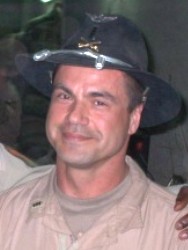
The President of the United States of America, authorized by Act of Congress July 9, 1918 (amended by an act of July 25, 1963), takes pleasure in presenting the Silver Star to Chief Warrant Officer Three (CWO-3) Steven Tamsi Wells, United States Army, for conspicuous gallantry and intrepidity in action against the enemy while serving with Troop E, 7th Cavalry Regiment, 4th Brigade Combat Team, 1st Cavalry Division, in the face of an enemy attack on 8 August 2004, at Sadr City, Baghdad, Iraq. Chief Warrant Officer Three Wells provided the downed aircrew with direction, leadership, suppressive fire, and an attempt at extractions. He put himself in extreme danger and personified the tenets of the Soldier’s Creed and the Army Values. Chief Warrant Officer Three Wells’ actions represent the finest traditions of the Military and reflect highly upon himself, 1st Cavalry Division, Multi-National Corps Iraq, and the United States Army.
NARRATIVE TO ACCOMPANY AWARD:
Chief Warrant Officer Three Steven T. Wells is recommended for the Silver Star for his conspicuous gallantry on 8 August 2004, as he attempted the rescue of his wingman after they were shot down in Sadr City, Iraq. On 8 August 2004, Chief Warrant Officer Three Wells and his team were conducting reconnaissance in and around Sadr City when his sister ship, BOUNTYHUNGER 13 was struck with an RPG and executed a hard landing on the north west side of Sadr City, Baghdad. After determining that the crew had crashed, and while the downed crew was still trying to extract itself from the inverted aircraft under fire, Chief Warrant Officer Three Wells immediately maneuvered back to the center of the air and ground ambush to determine the status of the crew. While in the process of this action, their crew received heavy small arms, machine gun, and RPG fire and witnessed several enemy RPG and small arms gunners approaching the aircraft. Without hesitation, Chief Warrant Officer Three Steve Wells made an immediate engagement from an altitude of less than 200 feet on a rooftop RPG team who was within 70 meters of the crash site. After performing multiple evasive maneuvers to avoid the heavy volume of enemy fire, Chief Warrant Officer Three Wells returned again to determine the status of the downed aircrew and in the process noticed a large group of personnel approaching from the southeast at a distance of roughly four city blocks. Knowing that the aircrew was still trying to make their way to friendly forces, Chief Warrant Officer Three Wells made an engagement with several rockets between the crash site and the group of Iraqi personnel, preventing them from advancing any further north. While still under heavy fire, Chief Warrant Officer Three Wells made two low level orbits of the area at approximately 30 feet above the city and gained visual contact with the egressing aircrew, and provided hand and arm signals to direct the downed crew toward friendly elements. During this maneuvering, Chief Warrant Officer Three Wells once gain observed armed enemy with small arms and RPG weapons advancing towards the downed aircrew, this time from the northeast. Chief Warrant Officer Three Wells immediately executed two separate close combat attacks and expended all of his remaining rockets in the advancing formation. This action allowed the downed aircrew to move past a mosque and to the vicinity of a large truck on route GRIZZLIES, north of the crash site. Making the determination that the downed crew’s only immediate recovery option was through self extraction, Chief Warrant Officer Wells made an attempt to land at the pilot’s last known location south of GRIZZLIES and provide them their only means for extraction. Under continuous fire, Chief Warrant Officer Three Wells made two initial attempts to land, both times having to break off due to power lines and obstacles that prevented the aircraft from touching down. Continuing to believe that the aircrew’s only attempt at recovery was through self-extraction, chief Warrant Officer Three Wells made an extremely dangerous, near vertical autorotation descent into the city, narrowly avoiding wires and buildings landing adjacent to Route GRIZZLIES. The area in which Chief Warrant Officer Three Wells landed the aircraft was less than ten feet on either side of his rotor disc for clearance of obstacles. While on the ground, the aircraft came under fire from small arms and one RPG round before they could determine that the downed pilots had moved beyond the immediate crash site to the north. Bringing the aircraft to it’s power limits, Chief Warrant Officer Three Wells made a vertical ascent and resumed an orbit of the crash site to regain visual contact with the downed crew. On takeoff, chief Warrant Officer Three Wells observed to armed Mahdi’s militiamen advancing northward and his co-pilot used an M-4 carbine to engage the enemy from their aircraft. Chief Warrant Officer Three Wells remained on station for another twenty minutes without ammunition and dwindling fuel attempting to provide reconnaissance and security to both the downed pilots and the advancing friendly forces. During this time, observers from Task Force LANCER (2-5 CAV) witnessed at least six more RPG’s fired in the maneuvering aircraft’s direction, in addition to continuous small arms fire that saturated the airspace. At approximately 1000 hours, Chief Warrant Officer Wells was relieved by two additional aircraft from Strike Battalion, and diverted to land at LX WASHINGTON, unable to return to base with their remaining fuel. Shortly after 1000 hours, the downed aircrew reached friendly forces and was successfully evacuated back to medical facilities. The actions of Chief Warrant Officer Three Wells were directly responsible for the safe recovery of the crew from the downed OH-58D. On three separate occasions, Chief Warrant Officer Three Wells intentionally placed his aircraft directly between enemy fire and the egressing aircrew. His well-aimed fire stopped a crowd of Mahdi Army insurgents from closing on the downed aircraft and drew fire away from the evading pilots. Chief Warrant Officer Three Wells’ absolute disregard for his own safety and his willingness to place himself directly in the line of enemy fire to protect other soldiers represents the highest level of gallantry and reflects the greatest credit on himself, Task Force 1-227th Aviation Regiment, the Fourth Brigade, First Cavalry Division, Multi-National Corps-Iraq and the United States Army.

Sponsored by:

Steven
Tamsi
Wells
Awards Received
-
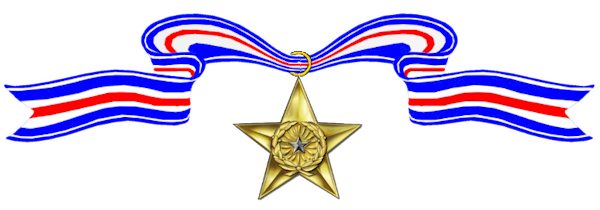
Silver Star
-
Silver Star
Service:
United States ArmyRank:
Chief Warrant Officer Three (CWO-3)Batallion:
1st BattalionRegiment:
7th Cavalry Regiment, 4th Brigade Combat TeamDivision:
1st Cavalry DivisionAction Date:
August 8, 2004