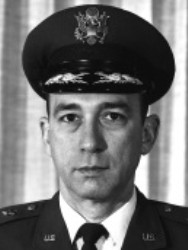
Paul Bacalis entered military service in 1941. After serving in the Army Air Forces in World War II, he transferred to the U.S. Air Force when it became a separate branch of service in 1947. He retired in 1973 as a U.S. Air Force Major General.

Sponsored by:

Paul
N.
Bacalis
1919
–
Awards Received
-

Distinguished Flying Cross
-

Air Force Distinguished Service Medal
-
Distinguished Flying Cross
-
Air Force Distinguished Service Medal
-

Silver Star
-
Distinguished Flying Cross
Service:
United States Army Air ForcesRank:
First Lieutenant (Air Corps)Batallion:
373d Bombardment SquadronRegiment:
308th Bombardment GroupDivision:
14th Air ForceAction Date:
World War II
(Citation Needed) – SYNOPSIS: First Lieutenant (Air Corps) Paul N. Bacalis (AFSN: FR-9227), United States Army Air Forces, was awarded the Distinguished Flying Cross for extraordinary achievement while participating in aerial flight while serving as Pilot of a B-24 Heavy Bomber of the 373d Bombardment Squadron, 308th Bombardment Group, FOURTEENTH Air Force, in the China-Burma-India Theater of Operations during World War II. His devotion to duty and courage under all conditions serve as an inspiration to his fellow flyers. His actions reflect the highest credit upon himself and the Armed Forces of the United States.
-
Air Force Distinguished Service Medal
Service:
United States Air ForceRank:
Brigadier GeneralAction Date:
August 1, 1966 – August 1, 1968
Department of the Air Force, Special Order GB-337 (July 3, 1968)The President of the United States of America, authorized by Act of Congress, July 9, 1918, takes pleasure in presenting the Air Force Distinguished Service Medal to Brigadier General Paul N. Bacalis (AFSN: FR-9227), United States Air Force, for exceptionally meritorious and distinguished service in a position of great responsibility to the Government of the United States, as Director of Special Projects, Central Control Group, Headquarters United States Air Force, from 1 August 1966 to 1 August 1968. During this period, General Bacalis’ outstanding leadership, initiative, and professional acumen resulted in the development of highly sophisticated systems and procedures producing noteworthy results and contributing directly to the national security. In addition, General Bacalis reflected the epitome in executive management techniques in directing research and development efforts, planning and programming funds and personnel, and coordinating matters between various agencies of the United States Government. The singularly distinctive accomplishments of General Bacalis reflect the highest credit upon himself and the United States Air Force.
-
Distinguished Flying Cross
Service:
United States Army Air ForcesRank:
First Lieutenant (Air Corps)Batallion:
373d Bombardment SquadronRegiment:
308th Bombardment GroupDivision:
14th Air ForceAction Date:
World War II
(Citation Needed) – SYNOPSIS: First Lieutenant (Air Corps) Paul N. Bacalis (AFSN: FR-9227), United States Army Air Forces, was awarded a Bronze Oak Leaf Cluster in lieu of a Second Award of the Distinguished Flying Cross for extraordinary achievement while participating in aerial flight while serving as Pilot of a B-24 Heavy Bomber of the 373d Bombardment Squadron, 308th Bombardment Group, FOURTEENTH Air Force, in the China-Burma-India Theater of Operations during World War II. His devotion to duty and courage under all conditions serve as an inspiration to his fellow flyers. His actions reflect the highest credit upon himself and the Armed Forces of the United States.
-
Air Force Distinguished Service Medal
Service:
United States Air ForceRank:
Major GeneralAction Date:
February 1, 1970 – February 28, 1973
Department of the Air Force, Special Order GB-9 (January 12, 1973)The President of the United States of America, authorized by Act of Congress, July 9, 1918, takes pleasure in presenting a Bronze Oak Leaf Cluster in lieu of a Second Award of the Air Force Distinguished Service Medal to Major General Paul N. Bacalis (AFSN: FR-9227), United States Air Force, for exceptionally meritorious and distinguished service in a position of great responsibility to the Government of the United States. General Bacalis distinguished himself while serving in consecutive positions as Assistant Deputy Chief of Staff, Materiel, Assistant Deputy Chief of Staff, Plans, and Deputy Chief of Staff, Plans, Strategic Air Command, from 1 February 1970 to 28 February 1973. During this period, General Bacalis’ outstanding achievements and his dynamic leadership and initiative resulted in immeasurable contributions to the Strategic Air Command and the security of the nation. The singularly distinctive accomplishments of General Bacalis culminate a long and distinguished career in the service of his country and reflect the highest credit upon himself and the United States Air Force.
-
Silver Star
Service:
United States Army Air ForcesRank:
Captain (Air Corps), [then First Lieutenant]Batallion:
373d Bombardment SquadronRegiment:
308th Bombardment Group (H)Division:
14th Air ForceAction Date:
November 10, 1944
Headquarters, 14th Air Force, General Orders No. 33 (April 9, 1945)The President of the United States of America, authorized by Act of Congress July 9, 1918, takes pleasure in presenting the Silver Star to Captain (Air Corps), [then First Lieutenant] Paul N. Bacalis (AFSN: FR-9227), United States Army Air Forces, for conspicuous gallantry and intrepidity in action against the enemy while serving as Pilot of a B-24 Liberator Bomber of the 373d Bombardment Squadron, 308th Bombardment Group (Heavy), FOURTEENTH Air Force. On the night of 10 November 1944, Captain Bacalis piloted a heavy bombardment type aircraft in an attack on an enemy destroyer in the South China Sea. His bombs fell in front of the destroyer on the first run and he decided to make a second run at very low altitude to insure accuracy, although the destroyer had been alerted by the first attack and the explosion of its own bombs could cause damage to the aircraft at this low level. Despite a heavy barrage of anti-aircraft fire which damaged the wing of his plane, Captain Bacalis maintained a direct course and dropped his bombs on the destroyer. Secondary explosions followed the explosions of the bombs, sinking the destroyer and nearly throwing the aircraft out of control. In spite of the damage to the wing, Captain Bacalis retained control of the aircraft and returned safely to his home base. The gallantry demonstrated in this daring attack reflects honor upon his personal record and is in keeping with the finest traditions of the United States Army Air Forces.