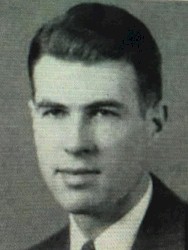
Born in Chehalis, Washington, Henry Jonas grew up on a dairy farm in Saint Anthony Idaho, where he was known as “Wild Bill” by his classmates for his exploits on the basketball court. He married in 1949, and attended the College of Idaho where he received a Bachelor’s Degree, and then received his Master’s of Divinity Degree from Princeton Seminary. He was ordained a Presbyterian minister and in 1945, he joined the military as was commissioned as a U.S. Army chaplain. He was active as a military chaplain in World War II, Korea, and Vietnam, and retired in 1974 after 30 years of service as a colonel. After retirement he worked as a Protestant Chaplain for the California Correctional Institute in Tehachapi, California, for eight years, and then became pastor of a small Community Presbyterian Church in Lee Vining, California, for nearly six years. While there, he was named the town’s “Citizen of the Year” in 1991. He then moved to Rancho Bernardo in 2002, and continued to volunteer his time with multiple charities in the San Diego area.

Sponsored by:

–
Cemetery:
Awards Received
-
Silver Star
-
Silver Star
Service:
United States ArmyRank:
First Lieutenant (Chaplain’s Corps)Regiment:
65th Infantry RegimentDivision:
3d Infantry DivisionAction Date:
June 15, 1953
Headquarters, 3d Infantry Division, General Orders No. 317 (5 August 1953)The President of the United States of America, authorized by Act of Congress, July 9, 1918, takes pleasure in presenting the Silver Star to First Lieutenant (Chaplain’s Corps) Henry F. Jonas (ASN: 0-1119072), United States Army, for conspicuous gallantry and intrepidity in action while serving as a Chaplain assigned to Headquarters and Headquarters Company, 65th Infantry Regiment, 3d Infantry Division. On the night of 14 June and during the early morning hours of 15 June 1953, in the vicinity of Sagimak, Korea, Company E attacked an enemy held outpost known as Hill 412. During the attack, the objective and all approaches were subjected to intense artillery, rocket and mortar and small arms concentrations. As casualties began returning to the lines, Chaplain Jonas, with complete disregard for his personal well-being, moved down the safe lane to meet and guide them to safety and medical aid. He moved about, giving comfort and encouragement to the wounded and guided blinded men to safety. Observing indigenous litter bearers wandering about in confusion, he organized them into efficient litter teams and led them to the casualties. One walking wounded had lost his steel helmet and Chaplain Jonas immediately gave his own helmet to the wounded man, continuing through the fire without this protection. When the wounded asked for water, he appeared with a supply and saw that each man had some, depending on the nature of the wounds. When casualties could not be evacuated by litter teams, he personally carried several men to the comparative safety of the lines. Chaplain Jonas’ outstanding gallantry and devotion to duty reflect great credit upon himself and the military service.