A veteran fighter pilot of World War II, during the Korean War Robert Baldwin became an ACE credited with the destruction of 5 enemy aircraft in aerial combat plus 3 damaged. He retired as a U.S. Air Force Colonel in 1966.

Sponsored by:

Robert
Percy
Baldwin
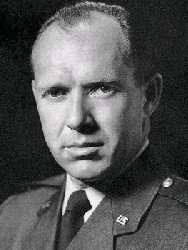
October 19, 1917
–
April 7, 1994
Cemetery:
Fort Rosecrans National Cemetery
Awards Received
-
Legion of Merit
-
Legion of Merit
-
Distinguished Flying Cross
-

Silver Star
-
Distinguished Flying Cross
-
Legion of Merit
Service:
United States Air ForceRank:
ColonelAction Date:
June 23, 1962 – June 28, 1965
Department of the Air Force, Special Orders GB-221 (August 19, 1965)The President of the United States of America, authorized by Act of Congress, 20 July 1942, takes pleasure in presenting a Bronze Oak Leaf Cluster in lieu of a Second Award of the Legion of Merit to Colonel Robert Percy Baldwin (AFSN: 0-7415A), United States Air Force, for exceptionally meritorious conduct in the performance of outstanding services to the Government of the United States as Director of Air Defense and Deputy Chief of Staff, Plans, Headquarters, Allied Air Forces Southern Europe, from 23 June 1962 to 28 June 1965. During this period, by exercising outstanding leadership and diplomacy, Colonel Baldwin directed all aspects of the operation, control and coordination of air defense forces and facilities of the Southern Air Defense Region assigned to the North Atlantic Treaty Organization. Because of his special ability to work harmoniously with other nationalities and services, he was extremely successful in directing his staff toward resolving problems involving present and future force goals. The singularly distinctive accomplishments of Colonel Baldwin reflect great credit upon himself and the United States Air Force.
-
Legion of Merit
Service:
United States Air ForceRank:
ColonelAction Date:
January 29, 1953 – July 20, 1953
The President of the United States of America, authorized by Act of Congress, 20 July 1942, takes pleasure in presenting the Legion of Merit to Colonel Robert Percy Baldwin (AFSN: 0-7415A), United States Air Force, for exceptionally meritorious conduct in the performance of outstanding services to the Government of the United States and the United Nations as Commander, 51st Fighter-Interceptor Group, FIFTH Air Force, from 29 January 1953 to 20 July 1953. In addition to filling the many requirements demanded of him by his responsible assignment, he demonstrated exceeding initiative and enthusiasm in solving service and design problems found in operating F-86 type aircraft. Colonel Baldwin recognized the necessity for a quick and effective remedy against continuing damage to aircraft caused by external fuel tank Jettison characteristics. In meeting this major requirement, Colonel Baldwin designed a lift spoiler for installation on external tanks with the result that he achieved a substantial reduction in aircraft damage caused by jettisoned tanks with a concomitant annual monetary saving of approximately thirty thousand dollars for each Fighter Interceptor Group. Colonel Baldwin further exhibited energetic leadership and exceptional ability through his active participation in resolving maintenance problems, particularly engine conditioning. Repeatedly he acted to insure that the jet engines of his organization were at peak effectiveness, and his drive in personally flight testing all engines reported for possible malfunctions generated a marked increase in engine life and high performance. Through his resourcefulness, keen professional ability and devotion to duty, Colonel Baldwin reflected the highest credit upon himself and the military service. great credit upon himself, the Far East Air Forces, and the United States Air Force.
-
Distinguished Flying Cross
Service:
United States Air ForceRank:
ColonelRegiment:
51st Fighter-Interceptor GroupAction Date:
March 14, 1953
The President of the United States of America, authorized by Act of Congress, July 2, 1926, takes pleasure in presenting the Distinguished Flying Cross to Colonel Robert Percy Baldwin (AFSN: 0-7415A), United States Air Force, for extraordinary achievement while participating in aerial flight while flying aerial combat over North Korea with the 51st Fighter-Interceptor Wing on 14 March 1953. Colonel Baldwin, leading a flight of four F-86 type aircraft near the Yalu River, sighted four MiG-15 type aircraft. As the enemy crossed under him Colonel Baldwin maneuvered into position for an attack on the number two MiG. Colonel Baldwin began firing and continued to close and press his attack. Numerous hits and a secondary explosion were immediately noted in the right wing root of the enemy aircraft. The aircraft began burning and trailing heavy gray smoke, as Colonel Baldwin continued firing, scoring extensive and effective hits. When last observed, the aircraft was burning heavily and emitting dark smoke. Colonel Baldwin’s aggressiveness accounted for one MiG-15 destroyed on this mission. His flying ability and mental alertness have been outstanding, and his courage and devotion to duty have brought great credit upon himself and the United States Air Force.
-
Silver Star
Service:
United States Air ForceRank:
ColonelRegiment:
51st Fighter-Interceptor GroupDivision:
5th Air ForceAction Date:
June 22, 1953
Headquarters, Far East Air Forces, General Orders No. 401 (November 2, 1953)The President of the United States of America, authorized by Act of Congress July 9, 1918, takes pleasure in presenting the Silver Star to Colonel Robert Percy Baldwin (AFSN: 0-7415A), United States Air Force, for gallantry in action while serving as Pilot of an F-86 Sabrejet Fighter-Bomber and as Commanding Officer of the 51st Fighter-Interceptor Group, FIFTH Air Force, in action on 22 June 1953, in Korea. Colonel Baldwin distinguished himself while leading four (4) F-86 type aircraft on a fighter sweep along the Manchurian Border. He sighted four (4) enemy MiG-15 type aircraft pressing an attack against two (2) friendly aircraft and immediately led his flight into the enemy. After successfully breaking up the enemy attack, Colonel Baldwin rolled down on the trailing MiG and fired a short burst into his left wing and fuselage. Colonel Baldwin continued to score numerous hits as heavy smoke poured from both wings and the enemy aircraft went into a steep dive through the clouds. Colonel Baldwin followed him through the cloud layer and pulled up sharply to avoid hitting the ground. Later reports confirmed the destruction of the MiG. By his personal courage and exceptional flying ability in this action, Colonel Baldwin is credited with destroying his fifth (5th) MiG-15 type aircraft. Throughout his tour, Colonel Baldwin’s aggressive spirit and mental alertness have brought great credit upon himself and the United States Air Force.
-
Distinguished Flying Cross
Service:
United States Air ForceRank:
ColonelRegiment:
51st Fighter-Interceptor GroupAction Date:
June 18, 1953
The President of the United States of America, authorized by Act of Congress, July 2, 1926, takes pleasure in presenting a Bronze Oak Leaf Cluster in lieu of a Second Award of the Distinguished Flying Cross to Colonel Robert Percy Baldwin (AFSN: 0-7415A), United States Air Force, for extraordinary achievement while participating in aerial flight with the 51st Fighter-Interceptor Wing on 18 June 1953. Colonel Baldwin, while flying leader in a flight of three F-86 type aircraft on a fighter patrol in North Korea, sighted two MiG-15 type aircraft break through an overcast and attack his wingman. Colonel Baldwin called his wingman to break right as the MiG’s opened fire and then pulled up in a steep right climb and fell down behind the attacking aircraft. He then fired in front of them to force them to break off their aggressive attack. As the MiG’s continued to fire and press their attack, Colonel Baldwin continued to fire and inflict extensive damage on the MiG until he fired out. Throughout his tour, Colonel Baldwin’s flying ability and aggressiveness in the face of the enemy has been outstanding, and his courage and devotion to duty have brought great credit upon himself and the United States Air Force.