The President of the United States of America takes pleasure in presenting the Distinguished Flying Cross to Major James W. Baker (MCSN: 0-19347), United States Marine Corps, for extraordinary achievement while participating in aerial flight against the enemy in Korea. On 10 November 1952, Major Baker led a flight of Marine attack aircraft in an assault on a vital and heavily defended enemy electrical power station in the vicinity of Chaeryong, North Korea. Upon approaching the target area, he directed his flight to remain at a safe altitude and descended to make an individual reconnaissance run to positively identify the objective. He then rejoined his flight and despite intense and accurate anti-aircraft fire, led and directed repeated bombing and rocket assaults that completely demolished the transformer building and surrounding high tension terminals. Major Baker’s outstanding leadership in organizing and directing the attack was largely responsible for the success of a mission that seriously reduced the electric power available to the enemy. His courageous actions, professional skill, and devotion to duty throughout reflected great credit upon himself and were in keeping with the highest traditions of the United States Naval Service.

Sponsored by:

Awards Received
-
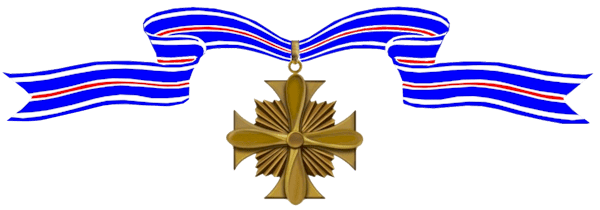
Distinguished Flying Cross
-
Distinguished Flying Cross
Service:
United States Marine CorpsRank:
MajorBatallion:
Marine Attack SquadronAction Date:
December 14, 1952
Commanding General 1st Marine Aircraft Wing: Serial: 8934 (June 17, 1953The President of the United States of America takes pleasure in presenting a Gold Star in lieu of a Second Award of the Distinguished Flying Cross to Major James W. Baker (MCSN: 0-19347), United States Marine Corps, for extraordinary achievement while participating in aerial flight against the enemy as a member of a Marine Attack Squadron in Korea. On 14 December 1952, Major Baker led a flight of four Marine attack aircraft against a heavily defended enemy troop concentration and supply center near the coastal area of Chonnang-ni. Temporarily diverted from his primary target to search for a large cave suspected of housing an enemy ammunition dump, Major Baker conducted a low level reconnaissance. He quickly detected the cave and initiated a rocket assault that scored several damaging hits. Proceeding to his previously assigned target, he instructed the flight to orbit out of range of hostile weapons while he conducted an attack through intense hostile anti-aircraft fire. After deliberately exposing himself to the hostile fire to make certain his flight has spotted the anti-aircraft positions, Major Baker controlled each bombing run with such skill that complete destruction of the enemy installation was achieved and heavy enemy casualties were inflicted. During the final attack on the target, one of the attacking aircraft was hit by the increasingly accurate hostile fire and the pilot was forced to parachute into the icy water off of the coast of North Korea. Immediately alerting rescue facilities, Major Baker directed the remainder of his flight to establish a protective cover over the downed pilot while he made repeated low sweeps, one more exposing himself to enemy fire, in order to keep the pilot in sight. His cool, clear instructions to the helicopter rescue team brought about a swift and successful rescue of the downed pilot. His courageous actions, professional skill, and devotion to duty throughout reflected great credit upon himself and were in keeping with the highest traditions of the United States Naval Service.