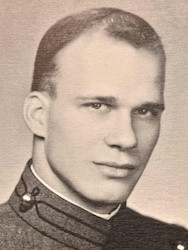
Bruce Wilson graduated from the U.S. Military Academy at West Point, New York, Class of 1966. He retired in 1989 as a U.S. Army Lieutenant Colonel.

Sponsored by:

Bruce
Mackie
Wilson
Born:
,
Washington
Home:
Spokane
,
Washington
Awards Received
-
Silver Star
-
Silver Star
Service:
United States ArmyRank:
Captain (Infantry)Batallion:
4th Battalion (Airborne)Regiment:
503d Infantry Regiment, 173d Airborne Brigade (Separate)Action Date:
February 25, 1969
Headquarters, I Field Forcee, Vietnam, General Orders No. 409 (June 30, 1969)The President of the United States of America, authorized by Act of Congress July 9, 1918 (amended by an act of July 25, 1963), takes pleasure in presenting the Silver Star to Captain (Infantry) Bruce Mackie Wilson (ASN: OF-108040), United States Army, for gallantry in action. Captain Wilson distinguished himself by gallantry in action while engaged in military operations against a hostile armed force in the Republic of Vietnam on 25 February 1969, while serving as Company Commander of Company A, 4th Battalion (Airborne), 503d Infantry Regiment, 173 Airborne Brigade (Separate). Company A engaged an unknown size enemy force in the remote jungles of the Tuy Hoa area of operations. As initial contact broke, Company A came under intense automatic weapons fire, which killed and wounded most of the lead squad. Captain Wilson rallied his company and led an assault on the complex to allow the removal of the wounded who were unable to move because of the withering enemy fire. Two wounded were stranded in enemy trenches after the initial assault. Captain Wilson moved to an exposed position where he could observe and direct the firepower of supporting gunships, drawing heavy fire as he did. The gunships were ineffective due to the proximity of the enemy. Captain Wilson was forced to resort to a second charge on the enemy positions. Armed only with a .45 caliber pistol, Captain Wilson reached the initial trench system and secured it by himself. Inspired by his example, his men moved to the trench line. Captain Wilson then went on a reconnaissance of the trench line, moving alone through the trench system until he located his wounded personnel. Captain Wilson had the company withdraw to safety. He then directed devastating mortar fire upon the enemy positions from a mound only fifty feet from the enemy. Through his personal courage and aggressiveness, Captain Wilson instilled renewed confidence and determination in his battle-weary soldiers, resulting in the defeat of a numerically superior force. Captain Wilson’s courage, determination, and extraordinary heroism in close combat against an enemy force were in keeping with the highest traditions of the military service and reflect great credit upon himself, his unit, and the United States Army.