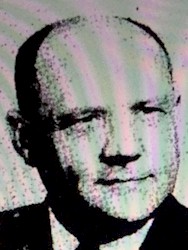
David Reardon grew up in Buffalo Center, Iowa, and received his Bachelor of Divinity degree at the University of Dubuque Theological Seminary in 1935. He was ordained a minister in the Reformed Church in America, and began his ministry as pastor of the Reformed Church in Dumont, Iowa. He left that pastorate in 1940 to enter military service and was commissioned a U.S. Army chaplain, serving for thirty years including service in both World War II and the Korean War. After the Korean War he served at Fort Devon, Massachusetts, as deputy chaplain, U.S. Army Communications zone in France, and as chaplain of the SEVENTH Army at Stuttgart, Germany. He received the Brai Brith Chaplains award in 1951.

Sponsored by:

David
Morris
Reardon
1909-09-21
–
1972-04-29
Born:
Buffalo Center
,
Iowa
Home:
Ackley
,
Iowa
Buried:
New Hurley
,
New York
Cemetery:
New Hurley Reformed Church Cemetery
Awards Received
-

Silver Star
-
Silver Star
Service:
United States ArmyRank:
Major (Chaplain’s Corps)Regiment:
15th Infantry RegimentDivision:
3d Infantry DivisionAction Date:
May 20, 1951
Headquarters, 3d Infantry Division, General Orders No. 347 (August 10, 1951)The President of the United States of America, authorized by Act of Congress July 9, 1918, takes pleasure in presenting the Silver Star to Major (Chaplain’s Corps) David Morris Reardon (ASN: 0-502235), United States Army, for gallantry in action as a member of Headquarters and Headquarters Company, 15th Infantry Regiment, 3d Infantry Division, in action against an armed enemy in Korea. On 20 May 1951, near Wadunji, Korea, Chaplain Reardon, present in the 3d Battalion forward aid station, learned that the wounded men of Company L could not be evacuated because of heavy enemy fire sweeping the area. Chaplain Reardon immediately proceeded to the battle scene in order to lend assistance in an attempt to remove the stricken soldiers from the battlefield. On the way, he encountered a soldier who had lost his steel helmet and unmindful of his own danger, the Chaplain unselfishly forced the man to take his own. Proceeding into the area, totally unprotected from the vicious enemy fire, he supervised the placing of the wounded on litter jeeps after urging the aidmen and drivers to move fearlessly about the hazardous terrain. During the action, Chaplain Reardon was wounded, but, thrusting aside all urgent suggestions that his injury be treated, he continued to render physical and spiritual assistance to those who required it. Not until all the wounded had been evacuated did he consent to leave with the last jeep, driving through the lethal hostile fire, to the safety of a nearby valley. Chaplain Reardon’s gallantry and self sacrifice reflects the highest credit upon himself and the military service.