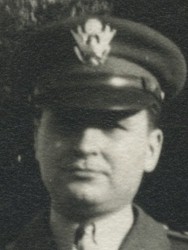
Stanley Kusman entered the postulate of the Marianists at Ferguson, Missouri, in 1920, at age twelve. He pronounced his first vows in 1924, and obtained a bachelor’s degree from the University of Dayton in 1928. He completed his studies for the priesthood at Fribourg, Switzerland, in 1934, and then obtained a master’s degree in philosophy at the Catholic University of America in Washington, D.C. in 1936. After brief assignments at Marianist high schools in Chicago, Dyersville, Canada, and St. Louis, he was assigned to St. Mary’s University in 1936. After four years, he returned to teaching high school at Chaminade in St. Louis, Missouri, until he entered military service in 1941, and was commissioned a U.S. Army chaplain. Assigned to a fighter unit of the TWELFTH Air Force in Italy, he felt his services were more needed with infantry and armored troops, and earned a Silver Star on the front lines of battle. After six years of military service, he returned to St. Mary’s University in 1943, serving as chaplain and professor of philosophy until 1953, when he began work as a missionary in Japan. Five years later he returned home and continued to preach Better World Retreats until 1969. He returned to St. Mary’s University until he suffered a stroke in 1985.

Sponsored by:

–
Born:
,
Home:
,
Buried:
,
Cemetery:
Awards Received
-

Silver Star
-
Silver Star
Service:
United States Army Air ForcesRank:
Captain (Chaplain’s Corps)Division:
12th Air ForceAction Date:
September 3 – 16, 1943,
Headquarters, 12th Air Force, General Orders No. 11 (February 12, 1944)The President of the United States of America, authorized by Act of Congress July 9, 1918, takes pleasure in presenting the Silver Star to Captain (Chaplain’s Corps) Stanley J. Kusman (ASN: 0-426349), United States Army Air Forces, for gallantry in action against the enemy while serving as a Chaplain of a Fighter Group with the TWELFTH Air Force, at Salerno, Italy, during the period 3 to 16 September 1943. Chaplain Kusman learned that one salient was without the services of a chaplain and that as a result, many of the dead were not being buried. Going alone and unarmed far beyond the American front lines, he sought out the bodies of fallen soldiers from the usually well-concealed places where the died, carried them on his shoulders to places where it was possible to dig graves in the rocky soil, and carefully marked each grave. Many times each day he was the target for enemy artillery and machine-gun fire, and several times was fired on by friendly troops. In a ten-day period, he discovered and buried the bodies of 47 Americans and 10 Germans. Because of the extremely dangerous nature of the work, Chaplain Kusman would not allow anyone to accompany him, although many soldiers, inspired by his courage, volunteered to do so. The gallant actions and dedicated devotion to duty demonstrated by Chaplain Kusman, without regard for his own life, were in keeping with the highest traditions of military service and reflect great credit upon himself and the United States Army Air Forces.