On July 1, 1960, a U.S. Air Force RB-47 aircraft with a crew of six was shot down over the Barents Sea. Captains John McKone and Freeman Olmstead were rescued by a Soviet trawler and held captive at Lubyanak prison until January 25, 1961 when they were released. The remains of one crewman, Willard Palm, were recovered and returned July 25, 1960. The other three crewman: Oscar Goforth, Dean Phillips, and Eugene Posa, remain missing in action.

Sponsored by:

Freeman
Bruce
Olmstead
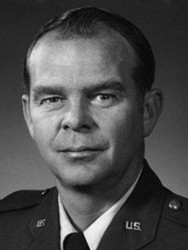
POW (Cold War)
June 17, 1935
–
Born:
Elmira
,
New York
Home:
Elmira
,
New York
Awards Received
-
Prisoner of War Medal
Service:
United States Air ForceRank:
Colonel [then Captain]Division:
Prisoner of War (Soviet Union)Action Date:
July 1, 1960 – January 24, 1961
Captain (then) John R. McKone (AFSN: FR-62063), United States Air Force, and Captain (then) Freeman Bruce Olmstead (AFSN: FR-54818), United States Air Force, were crew members on a U.S. Air Force RB-47 that took off from Briuze Norton Air Base, United Kingdom, on 1 July 1960, to fly a peace time reconnaissance mission against the Soviet Union. At a predetermined point the RB-47 flew in a southeast direction in the Barents Sea parallel to the northern Soviet coastline. While over international waters, the RB-47 was intercepted by a Soviet MiG fighter which started firing o the aircraft and subsequently shot the RB-47 down. Of the six RB-47 crew members, Captain Olmstead, the co-pilot and Captain McKone, the navigator, survived the shoot down. After spending six hours in the freezing arctic waters, Captains Olmstead and McKone were rescued by a Soviet fishing trawler, transferred to an aircraft and flown to Moscow. They then were separated and placed in solitary confinement for 208 days in Lubyanak prison, the top political prison of the KGB. On 24 January 1961 they were released to American authorities at the American Embassy in Moscow. The singularly distinctive accomplishments of Colonel (USAF Ret) John R. McKone and Colonel (USAF Ret) Freeman B. Olmstead reflect great credit upon themselves, the reconnaissance community and the United States Air Force.
-
Distinguished Flying Cross
Service:
United States Air ForceRank:
CaptainBatallion:
343d Strategic Reconnaissance SquadronRegiment:
55th Strategic Reconnaissance WingAction Date:
July 1, 1960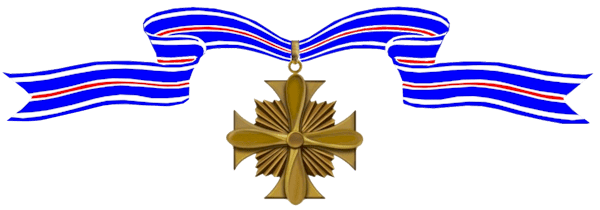
Department of the Air Force, Special Orders G-40 (May 3, 1962)The President of the United States of America, authorized by Act of Congress, July 2, 1926, takes pleasure in presenting the Distinguished Flying Cross to Captain Freeman Bruce Olmstead (AFSN: FR-54818), United States Air Force, for extraordinary achievement while participating in aerial flight on 1 July 1960. The effectiveness and courage exhibited by Captain Olmstead in the accomplishment of this mission, under exceptional conditions, ably demonstrated his proficiency and steadfast devotion to duty. The professional ability and airmanship displayed by Captain Olmstead reflect great credit upon himself and the United States Air Force
-
Silver Star
Service:
United States Air ForceRank:
Colonel [then Captain]Batallion:
343d Strategic Reconnaissance SquadronRegiment:
55th Strategic Reconnaissance WingAction Date:
July 1, 1960 – January 24, 1961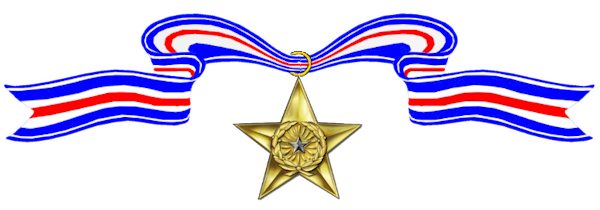
The President of the United States of America, authorized by Act of Congress July 9, 1918, takes pleasure in presenting the Silver Star to Colonel [then Captain] Freeman Bruce Olmstead (AFSN: FR-54818), United States Air Force, for gallantry in connection with military operations against an opposing armed force from 1 July 1960 to 24 January 1961. During this period, while assigned to the 343rd Strategic Reconnaissance Squadron, 55th Strategic Reconnaissance Wing, Colonel Olmstead was held captive in solitary confinement in the infamous Lubyanka Prison, Moscow, in the former United of Soviet Socialist Republics, after his crew’s RB-47 aircraft had been shot down by a Soviet fighter aircraft over international waters. For 208 days, Colonel Olmstead was interrogated and harassed at length on a continuous basis by numerous top Soviet Secret Police interrogating teams. Although greatly weakened physically by the lack of food, denial of sleep, and the mental rigors of constant interrogation, Colonel Olmstead steadfastly refused all attempts to give sensitive defense information or be exploited for propaganda purposes, resisting all Soviet efforts through cajolery, trickery, and threats of death to obtain the confessions they sought as part of the pretrial investigation. After enduring seven months of threats, insults, and unmentionable hardship, Colonel Olmstead was finally released to United States control. As a result of his indomitable spirit, exceptional loyalty, and continuous heroic actions, a “showcase trial” was never conducted, earning him the everlasting gratitude of his fellow prisoner and country as well as gaining respect of his Soviet captors. For his sustained courage and extraordinary leadership in an exceptionally hostile environment, Colonel Olmstead was publicly recognized at the highest levels of government, including the President of the United States. By his gallantry and devotion to duty, Colonel Olmstead has reflected great credit upon himself and the United States Air Force.