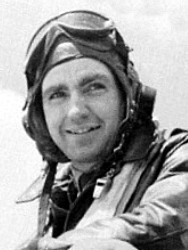
During World War II, John Thornell became a U.S. Army Air Forces TRIPLE ACE, credited with shooting down 17.25 enemy aircraft in aerial combat. After the war he transferred to the new U.S. Air Force, and retired in 1972 as a Lieutenant Colonel.

Sponsored by:

John
Francis
Thornell
, Jr.
April 19, 1921
–
September 3, 1998
Cemetery:
Riverside National Cemetery
Awards Received
-

Distinguished Flying Cross
-

Distinguished Service Cross
-
Distinguished Flying Cross
-

Silver Star
-
Distinguished Flying Cross
-
Distinguished Flying Cross
-
Distinguished Flying Cross
-
Silver Star
-
Distinguished Flying Cross
-
Distinguished Flying Cross
Service:
United States Army Air ForcesRank:
First Lieutenant (Air Corps)Batallion:
328th Fighter SquadronRegiment:
352d Fighter GroupDivision:
8th Air ForceAction Date:
April 2, 1944
(Citation Needed) – SYNOPSIS: First Lieutenant (Air Corps) John Francis Thornell, Jr. (ASN: 0-797743), United States Army Air Forces, was awarded a Second Bronze Oak Leaf Cluster in lieu of a Third Award of the Distinguished Flying Cross for extraordinary achievement while participating in aerial flight as a P-51 Fighter Pilot of the 328th Fighter Squadron, 352d Fighter Group, EIGHTH Air Force, in action against the enemy in aerial combat in the European Theater of Operations during World War II. The skillful and zealous manner in which he has sought out the enemy and destroyed him, his devotion to duty and courage under all conditions serve as an inspiration to his fellow flyers. His actions on all these occasions reflect the highest credit upon himself and the Armed Forces of the United States.
-
Distinguished Service Cross
Service:
United States Army Air ForcesRank:
First Lieutenant (Air Corps)Batallion:
328th Fighter SquadronRegiment:
352d Fighter GroupDivision:
8th Air ForceAction Date:
May 8, 1944
Headquarters, U.S. Strategic Forces in Europe, General Orders No. 44 (July 22, 1944)The President of the United States of America, authorized by Act of Congress, July 9, 1918, takes pleasure in presenting the Distinguished Service Cross to First Lieutenant (Air Corps) John Francis Thornell, Jr. (ASN: 0-797743), United States Army Air Forces, for extraordinary heroism in connection with military operations against an armed enemy while serving as Pilot of a P-51 Fighter Airplane in the 328th Fighter Squadron, 352d Fighter Group, EIGHTH Air Force, in aerial combat against enemy forces on 8 May 1944, in the European Theater of Operations. On this date, Lieutenant Thornell, with complete disregard for the odds against him, led a flight against a vastly superior force of enemy fighters in the vicinity of Nienburg, Germany, and dispersed the enemy attempting to intercept a friendly bomber formation. Determined to destroy the enemy, accompanied by two other friendly fighters he attacked three enemy fighters and by courageous flying and skillful gunnery destroyed two of them. Later, Lieutenant Thornell was attacked by a lone enemy fighter whom he outmaneuvered and destroyed, bringing his total for the day to three enemy airplanes destroyed. The outstanding courage, coolness, and skill displayed by Lieutenant Thornell upon this occasion reflect highest credit upon himself and the Armed Forces of the United States.
-
Distinguished Flying Cross
Service:
United States Army Air ForcesRank:
First Lieutenant (Air Corps)Batallion:
328th Fighter SquadronRegiment:
352d Fighter GroupDivision:
8th Air ForceAction Date:
April 2, 1944
(Citation Needed) – SYNOPSIS: First Lieutenant (Air Corps) John Francis Thornell, Jr. (ASN: 0-797743), United States Army Air Forces, was awarded a Fourth Bronze Oak Leaf Cluster in lieu of a Fifth Award of the Distinguished Flying Cross for extraordinary achievement while participating in aerial flight as a P-51 Fighter Pilot of the 328th Fighter Squadron, 352d Fighter Group, EIGHTH Air Force, in action against the enemy in aerial combat in the European Theater of Operations during World War II. The skillful and zealous manner in which he has sought out the enemy and destroyed him, his devotion to duty and courage under all conditions serve as an inspiration to his fellow flyers. His actions on all these occasions reflect the highest credit upon himself and the Armed Forces of the United States.
-
Silver Star
Service:
United States Army Air ForcesRank:
Captain (Air Corps), [then First Lieutenant]Batallion:
328th Fighter SquadronRegiment:
352d Fighter GroupDivision:
8th Air ForceAction Date:
June 10, 1944
Headquarters, 8th Air Force, General Orders No. 467 (July 14, 1944)The President of the United States of America, authorized by Act of Congress, July 9, 1918, takes pleasure in presenting a Bronze Oak Leaf Cluster in lieu of a Second Award of the Silver Star to Captain (Air Corps), [then First Lieutenant] John Francis Thornell, Jr. (ASN: 0-797743), United States Army Air Forces, for gallantry in action while serving as a Pilot of a P-51 Mustang Fighter Airplane of the 328th Fighter Squadron, 352d Fighter Group, EIGHTH Air Force, while leading a flight of P-51 fighter aircraft, furnishing support for bombers on a mission over France, on 10 June 1944. During a strafing attack on a convoy of trucks, Captain Thornell and two members of his flight became separated from the balance of the squadron. Shortly after this, he saw a formation of approximately forty ME-109’s preparing to dive-bomb Allied position near *******. Completely disregarding the hazards of attacking such a vastly superior force, Captain Thornell led his flight in an aggressive assault. The enemy formation was so disrupted by the viciousness of this surprise attack that all except one flight jettisoned their bombs and turned to engage the three attackers. In the encounter which followed, his flight dispersed the enemy force, destroying three aircraft and damaging another, Captain Thornell personally accounting for the destruction of two of them. His gallantry and zeal in leading this daring attack are in keeping with the highest traditions of the Armed Forces of the United States.
-
Distinguished Flying Cross
Service:
United States Army Air ForcesRank:
First Lieutenant (Air Corps)Batallion:
328th Fighter SquadronRegiment:
352d Fighter GroupDivision:
8th Air ForceAction Date:
April 2, 1944
(Citation Needed) – SYNOPSIS: First Lieutenant (Air Corps) John Francis Thornell, Jr. (ASN: 0-797743), United States Army Air Forces, was awarded a Third Bronze Oak Leaf Cluster in lieu of a Fourth Award of the Distinguished Flying Cross for extraordinary achievement while participating in aerial flight as a P-51 Fighter Pilot of the 328th Fighter Squadron, 352d Fighter Group, EIGHTH Air Force, in action against the enemy in aerial combat in the European Theater of Operations during World War II. The skillful and zealous manner in which he has sought out the enemy and destroyed him, his devotion to duty and courage under all conditions serve as an inspiration to his fellow flyers. His actions on all these occasions reflect the highest credit upon himself and the Armed Forces of the United States.
-
Distinguished Flying Cross
Service:
United States Army Air ForcesRank:
First Lieutenant (Air Corps)Batallion:
328th Fighter SquadronRegiment:
352d Fighter GroupDivision:
8th Air ForceAction Date:
April 2, 1944
Headquarters, VIII Fighter Command, General Orders No. 33 (April 19, 1944)The President of the United States of America, authorized by Act of Congress, July 2, 1926, takes pleasure in presenting the Distinguished Flying Cross to First Lieutenant (Air Corps) John Francis Thornell, Jr. (ASN: 0-797743), United States Army Air Forces, for extraordinary achievement while serving with the VIII Fighter Command, EIGHTH Air Force. Lieutenant Thornell has accomplished forty fighter combat missions, or the equivalent thereof, over enemy occupied Continental Europe and has destroyed two enemy airplanes in aerial combat. The skillful and zealous manner in which this officer has sought out the enemy and engaged him in aerial combat, his devotion to duty and courage under all conditions serve as an inspiration to his fellow flyers. His actions on all these occasions reflect the highest credit upon himself and the Armed Forces of the United States.
-
Distinguished Flying Cross
Service:
United States Army Air ForcesRank:
First Lieutenant (Air Corps)Batallion:
328th Fighter SquadronRegiment:
352d Fighter GroupDivision:
8th Air ForceAction Date:
April 2, 1944
(Citation Needed) – SYNOPSIS: First Lieutenant (Air Corps) John Francis Thornell, Jr. (ASN: 0-797743), United States Army Air Forces, was awarded a Bronze Oak Leaf Cluster in lieu of a Second Award of the Distinguished Flying Cross for extraordinary achievement while participating in aerial flight as a P-51 Fighter Pilot of the 328th Fighter Squadron, 352d Fighter Group, EIGHTH Air Force, in action against the enemy in aerial combat in the European Theater of Operations during World War II. The skillful and zealous manner in which he has sought out the enemy and destroyed him, his devotion to duty and courage under all conditions serve as an inspiration to his fellow flyers. His actions on all these occasions reflect the highest credit upon himself and the Armed Forces of the United States.
-
Silver Star
Service:
United States Army Air ForcesRank:
First Lieutenant (Air Corps)Batallion:
328th Fighter SquadronRegiment:
352d Fighter GroupDivision:
8th Air ForceAction Date:
April 19, 1944
Headquarters, 8th Air Force, General Orders No. 446 (June 5, 1944)The President of the United States of America, authorized by Act of Congress, July 9, 1918, takes pleasure in presenting the Silver Star to First Lieutenant (Air Corps) John Francis Thornell, Jr. (ASN: 0-797743), United States Army Air Forces, for gallantry in action while serving as Pilot a P-51 Mustang Fighter Aircraft of the 328th Fighter Squadron, 352d Fighter Group, EIGHTH Air Force, on a bomber escort mission over Germany, on 19 April 1944. When the engine of Lieutenant Thornell’s plane developed a malfunction, he was unable to maintain contact with his unit and started the long return journey alone. Shortly thereafter, he observed a straggling B-17 being attacked by seven FW-190s. Though out-numbered by the enemy, Lieutenant Thornell made an aggressive head-on attack, heavily damaging one fighter and forcing the others to disperse. In the engagement which followed, he destroyed one FW-190 and then positioned himself on the tail of another, this, in spite of the fact that his own aircraft was not operating properly. Pressing the attack tenaciously, he followed the enemy fighter down to tree-top level, causing him to hit a tree, cartwheel and explode. The gallantry, aggressive fighting spirit and skill in combat displayed by Lieutenant Thornell resulted in the dispersal of an enemy force which would have been a hazard to other bombers in the vicinity.
-
Distinguished Flying Cross
Service:
United States Army Air ForcesRank:
First Lieutenant (Air Corps)Batallion:
328th Fighter SquadronRegiment:
352d Fighter GroupDivision:
8th Air ForceAction Date:
April 2, 1944
(Citation Needed) – SYNOPSIS: First Lieutenant (Air Corps) John Francis Thornell, Jr. (ASN: 0-797743), United States Army Air Forces, was awarded a Silver Oak Leaf Cluster in lieu of a Sixth Award of the Distinguished Flying Cross for extraordinary achievement while participating in aerial flight as a P-51 Fighter Pilot of the 328th Fighter Squadron, 352d Fighter Group, EIGHTH Air Force, in action against the enemy in aerial combat in the European Theater of Operations during World War II. The skillful and zealous manner in which he has sought out the enemy and destroyed him, his devotion to duty and courage under all conditions serve as an inspiration to his fellow flyers. His actions on all these occasions reflect the highest credit upon himself and the Armed Forces of the United States.