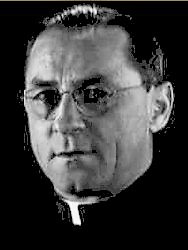
Joseph Barry graduated from Holy Rosary High School in Syracuse, New York, and entered Holy Cross Seminary in 1923. He went to Saint Joseph’s Novitiate a year later and made his first vows on August 15, 1925. After graduation from Notre Dame in 1929, he studied theology at Holy Cross College, Washington, D. C., and was ordained a Catholic priest in Sacred Heart Church, Notre Dame, on June 24, 1933. He was first pastor of the new Christ the King parish in South Bend, Indiana, and then assisted at Saint Joseph’s parish until 1941. He entered military service as a U.S. Army chaplain in 1941, serving until 1946, including the war campaigns in Africa, Sicily, and Italy, and then in the invasion of Southern France and Germany. After the war he spent two years as director of student affairs and prefect discipline at Notre Dame, and then as associate vocation director from 1949 to 1951. From 1952 to 1956 he was pastor of Sacred Heart Church and then was assistant prefect of religion until 1961. After two years as chaplain at Saint Joseph’s Hospital, South Bend, Indiana, he was appointed chaplain at Archbishop Hoban High School, Akron, Ohio, for 19 years until his retirement.

Sponsored by:

–
Born:
,
Home:
,
Buried:
,
Cemetery:
Awards Received
-

Silver Star
-
Silver Star
Service:
United States ArmyRank:
Captain (Chaplain’s Corps)Regiment:
157th Infantry RegimentDivision:
45th Infantry DivisionAction Date:
July 29, 1943
Headquarters, 45th Infantry Division, General Orders No. 153 (1944)The President of the United States of America, authorized by Act of Congress July 9, 1918, takes pleasure in presenting the Silver Star to Captain (Chaplain’s Corps) Joseph D. Barry, United States Army, for gallantry in action against the enemy while serving as Chaplain with the 157th Infantry Regiment, 45th Infantry Division, on or about 29 July 1943. When a company in his battalion suffered heavy casualties as a result of enemy fire near San Stefano, Sicily, Chaplain Barry disregarded intense fire to aid and comfort the wounded and to administer Last Rites to the dying. He directed evacuation of the wounded and refused to leave the area until all casualties were removed. Later he led searching parties into minefields to recover the bodies of men who had died. Chaplain Barry’s cool efficiency under fire and cheerful acceptance of danger and hardships were an inspiration to all who served with him and aroused the troops to greater efficiency. His conduct reflects high credit on the Chaplains Corps of the United States Army.