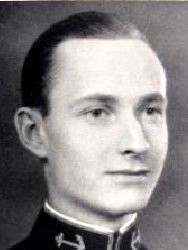
William Groverman graduated from the U.S. Naval Academy at Annapolis, Class of 1932. He retired as a U.S. Navy Rear Admiral.

Sponsored by:

William
Heald
Groverman
Jr.
1909-11-04
–
1996-12-25
Home:
Huntington
,
West Virginia
Awards Received
-
Legion of Merit
-
Silver Star
-
Silver Star
-
Legion of Merit
Board Serial 1334 (September 15, 1971)The President of the United States of America takes pleasure in presenting the Legion of Merit to Rear Admiral William Heald Groverman, Jr. (NSN: 0-71541/1100), United States Navy, for exceptionally meritorious service as Commander Western Sea Frontier from June 1967 through November 1971. Responsible for planning and conducting operations in defense of the Western Sea Frontier of the United States including Canada, Rear Admiral Groverman developed the readiness of his Command for operations in the event of national emergency, national disaster or war. Rear Admiral Groverman introduced new sonar techniques in convergence zone mode and standardization of environmental predictions, thus improving the Navy’s underwater detection capability. His expanded program of operations and exercises in anti-submarine warfare, naval reconnaissance, and ocean surveillance provided extensive evaluation with resulting modification of doctrine and equipment. By his outstanding professional competence, sound judgment, and inspiring devotion to duty, Rear Admiral Groverman reflected great credit upon himself and upheld the highest traditions of the United States Naval Service.
-
Silver Star
Service:
United States NavyRank:
Lieutenant CommanderDivision:
U.S.S. Philip (DD-498)Action Date:
August 15 – 18, 1943
The President of the United States of America takes pleasure in presenting a Gold Star in lieu of a Second Award of the Silver Star to Lieutenant Commander William Heald Groverman, Jr. (NSN: 0-71541/1100), United States Navy, for conspicuous gallantry and intrepidity in action against the enemy while serving as the Commanding Officer of the Destroyer U.S.S. PHILIP (DD-498), engaged in the initial occupation and subsequent reinforcement of Vella Lavella Island, British Solomon Islands, during the period from 15 to 18 August 1943. Despite three dive bombing and two torpedo plane attacks by Japanese air forces during the above mentioned period, Lieutenant Commander Groverman successfully completed a number of escort missions in protection of convoys carrying troops, supplies and equipment to the American garrison. By his courage, perseverance, and determination, he brought his ship through on each occasion without damage and prevented any damage to the vessels escorted. His courageous conduct materially contributed to the successful completion of the operation and was in keeping with the highest traditions of the United States Naval Service.
-
Silver Star
Service:
United States NavyRank:
Lieutenant CommanderDivision:
U.S. DestroyerAction Date:
July 5 – 6, 1943
The President of the United States of America takes pleasure in presenting the Silver Star to Lieutenant Commander William Heald Groverman, Jr. (NSN: 0-71541/1100), United States Navy, for conspicuous gallantry and intrepidity while serving as the Executive Officer of a United States Destroyer during the engagement with Japanese naval forces in the Kula Gulf, British Solomon Islands, on the night of 5 – 6 July 1943, and the subsequent rescue of survivors from a damaged cruiser. As Evaluating Officer in Combat Intelligence Center, Lieutenant Commander Groverman, by his skilful and intelligent evaluation of information received from special equipment, was able to supply his Commanding Officer with continuous tactical information which permitted the selection of targets for both torpedo fire and gunfire during the initial battle in which at least five enemy ships were sunk. Later during the same night, while his vessel rescued four hundred and forty-four survivors of a cruiser, his evaluation of information permitted his destroyer to get underway from the survival area, avoid enemy torpedoes and engage enemy ships with the result that one enemy cruiser was sunk, one destroyer probably sunk and one destroyer damaged, without damage to his own ship. His conduct was in keeping with the highest traditions of the United States Naval Service.