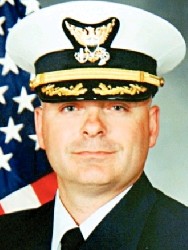
The President of the United States of America takes pleasure in presenting the Distinguished Flying Cross to Lieutenant Commander William E. Sasser, Jr., United States Coast Guard, for extraordinary achievement while participating in aerial flight from 29 August to 5 September 2005, as an HH-65 aircraft commander during Hurricane KATRINA rescue operations. Performing at the extreme limits of his skill and endurance, Lieutenant Commander Sasser flew 40 day and night flight hours performing a series of grueling and hazardous rescues throughout the urban disaster environment. On the night of 29 August, Lieutenant Commander Sasser commanded the first aircraft to depart Aviation Training Center, Mobile in the wake of Hurricane KATRINA. Canvassing the Mississippi coast at low level using night vision goggles, he located two survivors trapped in the attic of their flooded home. Displaying exceptional airmanship, Lieutenant Commander Sasser hovered at treetop level amongst flailing power lines, while battling 50 knot wind gusts, and lowered the swimmer to the roof. Fighting the elements for 25 minutes and maintaining this difficult position, he then hoisted both survivors and the rescue swimmer as they were extracted through a small hole in the roof. On the night of 30 August, he flew his aircraft to the extreme limits while rescuing 60 survivors from a school rooftop, maximizing payload on every rescue. During one departure, his aircraft began an uncontrollable descent as it reached power limits. He took immediate action, flying between two trees as the rotor blades passed only feet above their tops, narrowly escaping disaster. On 31 August, Lieutenant Commander Sasser located two survivors at night, trapped on a flooded home adjacent to a burning building. During the initial approach, his aircraft unexpectedly became power limited as the heat from the flames rapidly degraded engine performance and sending the aircraft towards the water. Displaying remarkable aeronautical skill, Lieutenant Commander Sasser aborted the approach, once again averting disaster. Undaunted, he repositioned the aircraft and, operating amongst the noxious smoke and fumes, expertly deployed the swimmer through a network of wires and poles, rescuing the survivors. For six consecutive days and nights, Lieutenant Commander Sasser’s actions, aeronautical skills and valor were instrumental in the rescue of 160 lives. His courage, judgment, and devotion to duty are most heartily commended and are in keeping with the highest traditions of the United States Coast Guard.

Sponsored by:

William
E.
Sasser
, Jr.
Home:
Mount Olive
,
North Carolina
Awards Received
-

Distinguished Flying Cross
-
Distinguished Flying Cross
Service:
United States Coast GuardRank:
Lieutenant CommanderAction Date:
August 29 – September 5, 2005