Ralph Koon graduated from the U.S. Military Academy at West Point, Class of 1928. He retired in 1958 as a U.S. Air Force Brigadier General.

Sponsored by:

Ralph
Edward
Koon
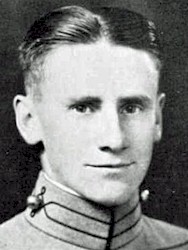
December 23, 1904
–
November 20, 1989
Born:
Bolivar
,
Missouri
Home:
Bolivar
,
Missouri
Cemetery:
Cremated (Ashes scattered under the Golden Gate Bridge)
Awards Received
-
Legion of Merit
-

Distinguished Service Cross
-
Legion of Merit
-
Legion of Merit
Service:
United States Army Air ForcesRank:
Colonel (Air Corps)Action Date:
October 1944 – March 1946
The President of the United States of America, authorized by Act of Congress, 20 July 1942, takes pleasure in presenting the Legion of Merit to Colonel (Air Corps) Ralph Edward Koon (ASN: 0-17197), United States Army Air Forces, for exceptionally meritorious conduct in the performance of outstanding service while serving with the SECOND Air Force and the FOURTH Air Force, from October 1944 to March 1946. Colonel Koon rendered exceptional services in the combat crew training program and contributed greatly to the development of staging procedures. Colonel Koon’s outstanding achievements and exemplary devotion to duty reflect great credit upon himself and the Army Air Forces.
-
Distinguished Service Cross
Service:
United States Army Air ForcesRank:
Colonel (Air Corps)Regiment:
90th Bombardment Group (H)Division:
5th Air ForceAction Date:
November 16, 1943 – July 8, 1944
Headquarters, U.S. Army Forces in the Far East, General Orders No. 1 (January 9, 1944)The President of the United States of America, authorized by Act of Congress July 9, 1918, takes pleasure in presenting the Distinguished Service Cross to Colonel (Air Corps) Ralph Edward Koon (ASN: 0-17197), United States Army Air Forces, for extraordinary heroism in action against an armed enemy while serving as Pilot of a B-24 Heavy Bomber in the 90th Bombardment Group (H), FIFTH Air Force, while participating in bombing missions from 16 November 1943 through 8 July 8, 1944, against enemy targets in the Southwest Pacific Area. Colonel Koon displayed exceptional courage and daring leadership in leading units of his group in eighteen combat missions over this period. These included strikes against Rabaul, Wewak, Kavieng and Ambon. On 10 April 1943, he commanded a bomber on an individual strike mission against enemy shipping in Wewak Harbor. In the face of heavy and accurate anti-aircraft fire, a bombing run was made on a cargo vessel, and a direct hit and damaging near-miss was scored. His aircraft was badly damaged in this attack, and the hydraulic system shot out; nevertheless, a second run was made on another vessel, which was destroyed by two direct hits. Despite the intense anti-aircraft fire and the damaged condition of his airplane, which made a crash-landing inevitable, a third attack was made on a large ship. Although the bombs had been expended, three strafing runs were made at minimum altitude, leaving the vessel in flames. Colonel Koon’s skill and heroism contributed substantially to the excellent combat record of his group.
-
Legion of Merit
Service:
United States Air ForceRank:
Brigadier GeneralAction Date:
July 1956 – July 1958
The President of the United States of America, authorized by Act of Congress, 20 July 1942, takes pleasure in presenting a Bronze Oak Leaf Cluster in lieu of a Second Award of the Legion of Merit to Brigadier General Ralph Edward Koon (ASN: 0-17197), United States Air Force, for exceptionally meritorious conduct in the performance of outstanding service to the United States as Vice Commander, Pacific Air Force, Far East Air Forces (Rear) from July 1956 to July 1957, and as Assistant Chief of Staff for Operations, Headquarters Pacific Air Forces, from July 1957 to July 1958. During this period, General Koon handled the many diverse problems attendant upon our positions as an Air Component of Pacific Command. Far-reaching questions and issues dealing with the relocation of Far East Air Forces Headquarters from Japan to Hawaii benefited by his judgment. He was also directly responsible for developing many Air Force decisions which have made a substantial contribution to our air power posture in the Pacific Area and his personal contacts with air leaders of the Asian community have fostered a high degree of understanding of the peaceful aims and objectives of the United States. Due to General Koon’s farsighted policy guidelines, many compatible force structure recommendations were adopted which are now forging the predominant lever of resistance to communist aims in this area of the world. His outstanding leadership, personal integrity, and devotion to duty reflect great credit upon himself and the United States Air Force.