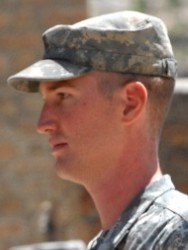
The President of the United States of America, authorized by Act of Congress July 9, 1918 (amended by an act of July 25, 1963), takes pleasure in presenting the Silver Star to First Lieutenant Loren Crowe, United States Army, for gallantry in action on 17 September 2008, in support of Operation ENDURING FREEDOM. First Lieutenant Crowe’s dedication to duty, courage under fire, and selfless service enabled 1st and 2d Platoon, Able Company, 1st Battalion, 26th Infantry Regiment, 1st Infantry Division, to kill over 20 anti-Afghan forces conducting an ambush in Asmar, Afghanistan. First Lieutenant Crowe’s ability to control the fight and protect his men is in keeping with the finest traditions of military service and reflects great credit upon himself, Task Force DUKE, Combined Joint Task Force-101, and the United States Army.
NARRATIVE TO ACCOMPANY AWARD:
First Lieutenant Loren Crowe’s heroic actions on 17 September 2008 saved the lives of his platoon members and repelled an enemy attack from over 30 Anti-Afghan Forces. That afternoon, First Lieutenant Crowe’s platoon was caught in a horrific close ambush. With six wounded and one killed in his patrol, and several vehicles disabled in the almost one kilometer kill zone, First Lieutenant Crowe aggressively dismounted his truck under fire, killed one enemy attempting to close the distance on the road and assault his rear element, call for and control indirect fires, and conduct a complicated vehicle recovery. His bravery saved the lives of his men as the enemy maneuvered on his element running across the road through his patrol element engaging with RPG and AK-47s at close range, then jumping to their death off a cliff on the opposite side of the road. First Lieutenant Crowe was the patrol leader during an operation in the Asmar District, Afghanistan. Upon completion of the clearing phase of the operation, First Lieutenant Crowe ordered his element and the support fire element to return to the vehicle patrol base and prepare for exfiltration back to COP MONTI. The assault element mounted the vehicles and pulled security while the SBF elements moved down from the high ground to their trucks. His interpreter was scanning the ICOM and intercepted the enemy; “ambush” is the only word they used indicating that an attack was possible. He moved the vehicles south along MSR CALIFORNIA in order to direct the enemy’s attention away from the dismounted support by fire element moving down from the high ground to their vehicles and gain a better position to observe any enemy activity in their vicinity. The two elements had approximately eight minutes of separation along the road. First Lieutenant Crowe ordered the two elements to begin movement south to return to COP MONTI. As the assault element began movement they came under direct fire from the high ground directly to their west. The enemy was positioned in a stacked ambush, with an element in the high ground to suppress CF, while an assault element waited in the low ground, tucked in hide, in a deep draw. First Lieutenant Crowe was the vehicle commander of the fourth vehicle and witnessed vehicles two and three receive direct RPG hits as well as a heavy volume of PKM fire. The second vehicle in the patrol was able to push through the kill zone; however the third vehicle became disabled. Stuck behind the disabled vehicle due to the road only allowing one lane of traffic, First Lieutenant Crowe witnessed the gunner of the vehicle in front of him, Sergeant Brandon Farley, aggressively engage the enemy from his static position. Sergeant Farley was eventually killed from enemy fire and fell from the turret into the vehicle. The vehicle was under intense PKM fire and received approximately nine RPG rounds on the vehicle. First Lieutenant Crowe called for immediate suppression from the 120-mm. mortars and located at COP MONTI, as well as relaying to the SBF element to put the 60-mm. mortars into action. This would be one of the only radio transmissions he would be able to make, as his vehicle came under fire and his communications platform was disabled. First Lieutenant Crowe made the decision to ram the disabled vehicle in front of him to get it out of the kill zone preventing further casualties. He was able to move the truck out of the immediate kill zone and simultaneously direct both direct and indirect fires onto the enemy. Unable to communicate with the vehicle behind him, under fire, he dismounted his vehicle and bounded to the vehicle commander behind him to give him instructions. At this point in the battle, First Lieutenant Crowe made a critical decision to push the first vehicle, which sustained multiple casualties, back to COP MONTI to facilitate casualty evacuation. Using his vehicle for cover, he identified one enemy moving to the rear truck in an attempt to assault the vehicle and its crew from close range. Instinctively, First Lieutenant Crowe engaged and killed the enemy dismount with his M-4. He and a small team of dismounts moved along the east side of the road using the trucks for cover engaging enemy personnel through the kill zone. The enemy in the low ground began assaulting and putting themselves between vehicles running across the road, engaging coalition forces, and leaping off the opposite cliff. First Lieutenant Crowe, using his dismounted radio, established communications with the SBF patrol leader as their trucks gained fire superiority enabling the assault element’s vehicles to clear the kill zone. First Lieutenant Crowe began a complicated and chaotic vehicle recovery operation using other trucks to push disabled vehicles to a safe location for recovery. During the recovery, the enemy was able to continue to place direct fires on the element and disabled First Lieutenant Crowe’s truck. He incorporated 155-mm. howitzers, 120-mm. mortars, relaying through attack aviation to support the vehicle recovery operation and support the SBF element now in contact fighting through the kill zone that still existed. Lieutenant Crowe was able to remain calm, and control a horrific ambush that wounded six soldiers and killed one U.S. Soldier. Under fire, he was able to regain communications with his higher headquarters through unconventional means, putting himself at great risk dismounting his vehicle while being engaged. His ability to manage artillery fire, mortar fire, close combat aviation, and attack aviation, all while facilitating a casualty evacuation, displayed a surreal level of discipline and heroism. His actions on 17 September 2008 not only prevented further casualties, but killed approximately 20 Anti-Afghan Forces. His actions saved the day. He is a proven combat leader who set an unmatched example for his men while under fire.

Sponsored by:

Loren
Crowe
Awards Received
-
Silver Star
-
Silver Star
Service:
United States ArmyRank:
First LieutenantBatallion:
1st BattalionRegiment:
26th Infantry RegimentDivision:
1st Infantry DivisionAction Date:
September 17, 2008