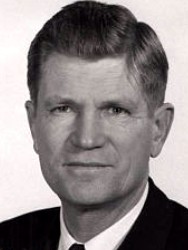
Ralph Weymouth graduated from the U.S. Naval Academy at Annapolis, Class of 1938. He retired as a U.S. Navy Vice Admiral.

Sponsored by:

Ralph
Weymouth
May 26, 1917
–
Awards Received
-
Distinguished Flying Cross
-
Distinguished Flying Cross
-
Distinguished Flying Cross
-
Legion of Merit
-
Legion of Merit
-
Navy Cross
-
Distinguished Flying Cross
-
Distinguished Flying Cross
Service:
United States NavyRank:
LieutenantBatallion:
Scouting Squadron 3 (VS-3)Action Date:
August 7, 1942
Bureau of Naval Personnel Information Bulletin No. 315 (June 1943)The President of the United States of America takes pleasure in presenting the Distinguished Flying Cross to Lieutenant Ralph Weymouth (NSN: 0-81252), United States Navy, for extraordinary achievement while participating in aerial flight as a scout bomber pilot in action against Japanese forces during the raid upon, and occupation of Guadalcanal, Solomon Islands, 7 August 1942. He sought out and destroyed assigned hostile anti-aircraft positions by vigorous bombing and strafing attacks which resulted in severe loss of life and equipment to the Japanese. By his effective aid in compelling the enemy to retire, he helped make it possible for our forces to occupy the area without opposition.
-
Distinguished Flying Cross
Service:
United States NavyRank:
Lieutenant CommanderBatallion:
Bombing Squadron 16 (VB-16)Division:
U.S.S. LexingtonAction Date:
April 29 & 30, 1944
Bureau of Naval Personnel Information Bulletin No. 356 (November 1946)(Citation Needed) – SYNOPSIS: Lieutenant Commander Ralph Weymouth (NSN: 0-81252), United States Navy, was awarded a Third Gold Star in lieu of a Fourth Award of the Distinguished Flying Cross for extraordinary achievement while participating in aerial flight as Commander of Bombing Squadron SIXTEEN (VB-16), embarked in U.S.S. LEXINGTON, over Truk Islands on 29 and 30 April 1944.
-
Distinguished Flying Cross
Service:
United States NavyRank:
LieutenantBatallion:
Scouting Squadron 3 (VS-3)Action Date:
October 1942
Bureau of Naval Personnel Information Bulletin No. 319 (October 1943)The President of the United States of America takes pleasure in presenting a Gold Star in lieu of a Second Award of the Distinguished Flying Cross to Lieutenant Ralph Weymouth (NSN: 0-81252), United States Navy, for extraordinary achievement while participating in aerial flight as a member of Scouting Squadron THREE (VS-3), in October 1942. After searching out an attacking a total of seven warships between Cape Esperance and Point Cruz, Lieutenant Weymouth by his vigilant performance of duty, sighted five enemy destroyers in the New Georgia Channel. Although fully aware of his vulnerable position, he remained over the vessels and shadowed them for more than an hour, meanwhile relaying his report to the base. In three subsequent flights, Lieutenant Weymouth led a section of planes in determined attacks on two light cruisers, fourteen destroyers and six transports and, with his men, destroyed an enemy transport and inflicted severe damage on the two light cruisers. His loyal devotion to duty, maintained without regard for his own personal safety, was in keeping with the highest traditions of the United States Naval Service.
-
Legion of Merit
All Hands (July 1969)(Citation Needed) – SYNOPSIS: Rear Admiral Ralph Weymouth (NSN: 0-81252), United States Navy, was awarded the Legion of Merit for exceptionally meritorious conduct in the performance of outstanding services to the Government of the United States as Commander Iceland Sector Antisubmarine Warfare Group, from January 1965 to January 1967, for his part in the development of a new concept of antisubmarine warfare operations.
-
Legion of Merit
All Hands (February 1969)(Citation Needed) – SYNOPSIS: Rear Admiral Ralph Weymouth (NSN: 0-81252), United States Navy, was awarded a Gold Star in lieu of a Second Award of the Legion of Merit for exceptionally meritorious conduct in the performance of outstanding services to the Government of the United States from 23 January 1968 to 25 June 1968, as Commander Antisubmarine Warfare Group ONE.
-
Navy Cross
Service:
United States NavyRank:
Lieutenant CommanderBatallion:
Bombing Squadron 16 (VB-16)Division:
U.S.S. Lexington (CV-16)Action Date:
June 20, 1944
Commander Fast Carrier Task Force Pacific: Serial 0362 (July 8, 1944)The President of the United States of America takes pleasure in presenting the Navy Cross to Lieutenant Commander Ralph Weymouth (NSN: 0-81252), United States Navy, for extraordinary heroism in operations against the enemy while serving as Pilot of a carrier-based Navy Dive Bomber and Commanding Officer of Bombing Squadron SIXTEEN (VB-16), attached to the U.S.S. LEXINGTON (CV-16), in action against the enemy fleet in the vicinity of the East Philippine Sea on 20 June 1944. Lieutenant Commander Weymouth led a large strike group of planes from Air Group SIXTEEN in an attack on Japanese carrier forces which were beyond the safe range limits of his planes. His flight of dive bombers scored seven direct hits on a large carrier not previously damaged and two direct hits on another. The torpedo bombers scored nine direct bomb hits on the carrier not previously damaged. He personally made a direct hit on the undamaged carrier. His attack resulted in the sinking of one carrier and the burning and probable sinking of another. The flight was under continuous aerial attack (even in the dives) for 25 minutes resulting in three planes being shot down by enemy aircraft while his flight shot down four enemy planes. The return flight was made at night with the additional hazard of a night carrier landing, low fuel and several damaged planes. His courage and disregard for his own safety were at all times in keeping with the highest traditions of the United States Naval Service.
-
Distinguished Flying Cross
Service:
United States NavyRank:
Lieutenant CommanderAction Date:
September 18 & October 5, 1943
Bureau of Naval Personnel Information Bulletin No. 340 (July 1945)(Citation Needed) – SYNOPSIS: Lieutenant Commander Ralph Weymouth (NSN: 0-81252), United States Navy, was awarded a Second Gold Star in lieu of a Third Award of the Distinguished Flying Cross for extraordinary achievement while participating in aerial flight as Pilot of a dive bomber at Tarawa and Wake on 18 September 1943 and 5 October 1943.