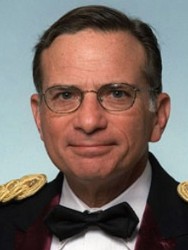
Floyd Kushner, an Army Ophthalmologist, was interned as a Prisoner of War in Cambodia and in North Vietnam after he was captured in South Vietnam on November 30, 1967, and was held until his release on March 16, 1973.

Sponsored by:

Floyd
Harold
Kushner
POW (RVN)
June 30, 1941
–
Awards Received
-
Bronze Star Medal
-

Prisoner of War Medal
-
Silver Star
-
Soldier’s Medal
-
Bronze Star Medal
Service:
United States ArmyRank:
Major (Medical Corps)Division:
Prisoner of War (Cambodia)Action Date:
November 30, 1967 – March 16, 1973
(Citation Needed) – SYNOPSIS: The President of the United States of America, authorized by Executive Order 11046, 24 August 1962, takes pleasure in presenting the Bronze Star Medal to Major (Medical Corps) Floyd Harold Kushner, United States Army, for meritorious achievement as a Prisoner of War while engaged in operations against an opposing armed force in North Vietnam during the period 30 November 1967 to 16 March 1973. In an atmosphere of enemy harassment and brutal treatment, he continued to establish and maintain communications through unusual and ingenious methods, which resulted in American and Allied prisoners presenting a posture of increased resistance to the enemy’s wishes and at the same time improving prisoner morale. His loyalty, diligence and devotion to duty were in keeping with the highest traditions of the military service and reflect great credit upon himself, his unit, and the United States Army.
-
Prisoner of War Medal
Service:
United States ArmyRank:
Major (Medical Corps)Division:
Prisoner of War (Cambodia)Action Date:
November 30, 1967 – March 16, 1973
Major (Medical Corps) Floyd Harold Kushner, United States Army, was held as a Prisoner of War in Southeast Asia from November 30, 1967 until his release on March 16, 1973.
-
Silver Star
Service:
United States ArmyRank:
Major (Medical Corps)Division:
Prisoner of War (Cambodia)Action Date:
July 29, 1969
Department of the Army, General Orders No. 56 (December 31, 1974)The President of the United States of America, authorized by Act of Congress, July 8, 1918 (amended by act of July 25, 1963), takes pleasure in presenting the Silver Star to Major (Medical Corps) Floyd Harold Kushner, United States Army, for exceptional gallantry in action while serving as a Prisoner of War on 29 July 1969. Major Kushner was interned in a prison camp in the jungles of Cambodia with other Americans. One American prisoner suffered a heart attack and was near death when Major Kushner was summoned. Despite the fact he was without equipment, he was able to revive the man. Major Kushner’s devotion to duty and exemplary achievement are in keeping with the highest traditions of the services and reflect great credit on himself and the United States Army.
-
Soldier’s Medal
Service:
United States ArmyRank:
Major (Medical Corps)Batallion:
1st SquadronRegiment:
9th Cavalry RegimentDivision:
1st Cavalry DivisionAction Date:
November 28, 1967
Department of the Army, General Orders No. 56 (December 31, 1974)The President of the United States of America, authorized by Act of Congress, July 2, 1926, takes pleasure in presenting the Soldier’s Medal to Major (Medical Corps) Floyd Harold Kushner, United States Army, for heroism at the risk of life not involving conflict with an armed enemy. Major Kushner distinguished himself by acts of exceptional valor on 28 November 1967, as Flight Surgeon, 1st Squadron, 9th Cavalry Regiment, 1st Cavalry Division. While on a combat support mission, the aircraft in which Major Kushner was a passenger crashed on a remote mountain top. Although severely injured, Major Kushner succeeded in freeing himself from the wreckage, and, at great personal risk and with great difficulty, pulled the critically injured co-pilot and crew chief to safety before the aircraft exploded and burned. In spite of his injuries and a bullet wound sustained when the aircraft ammunition exploded, Major Kushner remained at the crash site and administered aid, comfort, and medical attention to his fellow crewmen. When it became evident on 30 November that the co-pilot, Chief Warrant Officer Bedworth, was dying from internal injuries, Major Kushner, at Warrant Officer Bedworth’s insistence, left the crash site in an attempt to find a friendly unit and lead them to Warrant Officer Bedworth’s aid. Shortly thereafter, he was captured, and remained a Prisoner of War in South and North Vietnam for the next five years. Major Kushner’s heroic actions, dedication, and selfless sacrifice are in keeping with the highest traditions of the military service and reflect great credit upon himself and the United States Army.