Walter Howland graduated from the U.S. Air Force Academy at Colorado Springs, Colorado, Class of 1969. He retired in 1993 as a U.S. Air Force Lieutenant Colonel.

Sponsored by:

Walter
Theodore
Howland
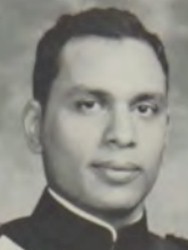
August 19, 1944
–
July 15, 2001
Born:
New York
,
New York
Home:
Bronx
,
New York
Buried:
Colorado Springs
,
Colorado
Cemetery:
U.S. Air Force Academy Cemetery
Awards Received
-

Distinguished Flying Cross
-
Distinguished Flying Cross
-
Distinguished Flying Cross
-
Distinguished Flying Cross
-
Silver Star
-
Distinguished Flying Cross
The President of the United States of America, authorized by Act of Congress, July 2, 1926, takes pleasure in presenting the Distinguished Flying Cross with Combat “V” to First Lieutenant Walter Theodore Howland, United States Air Force, for heroism while participating in aerial flight as an AC-119G Navigator in Southeast Asia on 20 March 1971. On that date, Lieutenant Howland’s AC-119G gunship was diverted to support a besieged friendly village that was under heavy attack and in danger of being overrun by a large hostile force. Despite intense antiaircraft fire which twice damaged his aircraft, he unerringly pinpointed targets and directed the gunship firepower for two hours, completely disregarding his personal safety. His actions were instrumental in silencing two antiaircraft sites, inflicting heavy casualties upon the hostile force, and suppressing the hostile attack. The outstanding heroism and selfless devotion to duty displayed by Lieutenant Howland reflect great credit upon himself and upheld the highest traditions of the United States Air Force.
-
Distinguished Flying Cross
The President of the United States of America, authorized by Act of Congress, July 2, 1926, takes pleasure in presenting a Third Bronze Oak Leaf Cluster in lieu of a Fourth Award of the Distinguished Flying Cross to First Lieutenant Walter Theodore Howland, United States Air Force, for extraordinary achievement while participating in aerial flight as an AC-130 Gunship Navigator over Southeast Asia on 10 February 1972. On that date, while on a night armed reconnaissance mission, his actions led to the damage or destruction of 17 hostile supply vehicles and the ignition of numerous secondary fires and explosions. Putting aside his concern for personal safety in the face of 510 rounds of hostile antiaircraft fire, he succeeded in destroying large amounts of supplies and munitions destined for use against friendly forces. The professional competence, aerial skill and devotion to duty displayed by Lieutenant Howland reflect great credit upon himself and upheld the highest traditions of the United States Air Force.
-
Distinguished Flying Cross
The President of the United States of America, authorized by Act of Congress, July 2, 1926, takes pleasure in presenting a Second Bronze Oak Leaf Cluster in lieu of a Third Award of the Distinguished Flying Cross to First Lieutenant Walter Theodore Howland, United States Air Force, for extraordinary achievement while participating in aerial flight as an AC-130 Gunship Infrared Sensor Operator over Laos on 5 March 1972. On that date, while on a night armed reconnaissance mission over heavily defended hostile supply routes, his actions led to the damage or destruction of 28 hostile supply vehicles and the creation of numerous secondary fires and explosions. Utilizing his sensor system to its fullest extent, he constantly sought out, validated and tracked enemy supply targets while coping with violent aircraft maneuvers to evade accurate antiaircraft fire, thereby making these extraordinary mission results possible. The professional competence, aerial skill and devotion to duty displayed by Lieutenant Howland reflect great credit upon himself and upheld the highest traditions of the United States Air Force.
-
Distinguished Flying Cross
The President of the United States of America, authorized by Act of Congress, July 2, 1926, takes pleasure in presenting a Bronze Oak Leaf Cluster in lieu of a Second Award of the Distinguished Flying Cross to First Lieutenant Walter Theodore Howland, United States Air Force, for extraordinary achievement while participating in aerial flight as an AC-119G Navigator in Southeast Asia on 13 May 1971. On that date, Lieutenant Howland’s gunship was diverted from a night armed reconnaissance mission to support a friendly outpost that was under heavy attack and in danger of being overrun by a large hostile force. Disregarding intense antiaircraft fire that threatened his personal safety, Lieutenant Howland coordinated with the ground commander, pinpointed and described targets to the Pilot, and directed the gunship firepower and illumination against the hostile force for over three hours. His actions were instrumental in silencing two mortar positions and three antiaircraft sites, inflicting heavy casualties upon the hostile troops, and in securing the outpost for the friendly forces. The professional competence, aerial skill and devotion to duty displayed by Lieutenant Howland reflect great credit upon himself and upheld the highest traditions of the United States Air Force.
-
Silver Star
U.S. Air Force Academy Southeast Asia Plaza of HeroesThe President of the United States of America, authorized by Act of Congress July 9, 1918 (amended by an act of July 25, 1963), takes pleasure in presenting the Silver Star to First Lieutenant Walter Theodore Howland, United States Air Force, for gallantry in action while engaged in military operations involving conflict with an armed hostile force as an AC-130 Gunship Infrared Sensor Operator over the Republic of Vietnam, on 23 April 1972. On that date, while on a night aerial fire support mission over a friendly ground position, his actions enabled the successful aerial helicopter rescue of friendly ground personnel who were undergoing heavy attack by a superior-sized hostile force. He displayed extraordinary gallantry and airmanship in continually pressing the attack to distract and prevent the advancing hostile force’s heavy armour and track mounted anti-aircraft artillery vehicles from firing upon friendly recovery efforts which were in progress. By his gallantry and devotion to duty, Lieutenant Howland has reflected great credit upon himself and upheld the highest traditions of the United States Air Force.