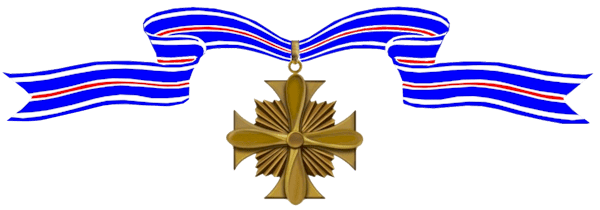
The President of the United States of America takes pleasure in presenting the Distinguished Flying Cross to Captain Arthur H. Ackerman (MCSN: 0-23257), United States Marine Corps, for extraordinary achievement while participating in aerial flight in support of the FIRST Marine Division and the FIRST Marine Aircraft Wing on 20 May 1951. The FIRST Marine Division was withdrawing from the enemy during their “fifth phase” offensive in the Korean Conflict. In providing many close support missions upon the advancing enemy, the Forward Echelons of the FIRST Marine Aircraft Wing Fighter Squadrons in the Hoengsong area developed a critical shortage of bombs, napalm, napalm tanks, and ammunition. Captain Ackerman, while serving as a pilot with the Forward Echelon of a Marine Transport Squadron, flew the vitally needed supplies into a hastily improvised dirt strip located on a river bed. The enemy had infiltrated into the area to the north of the strip. Extreme caution had to be used in approaching the field in order to avoid small arms and mortar fire. The weather was such as to require an instrument let-down on an unreliable homer in dangerous mountain terrain. Despite these hazards Captain Ackerman made this flight in a R-5D aircraft that was overloaded by more than 4,000 pounds. The aircraft was unarmed and loaded in a manner that the crew could not have abandoned it prior to off-loading the cargo. The arrival of the critically needed bombs, napalm, napalm tanks and ammunition enabled the Marine Fighter Squadrons to continue their close support missions, thereby inflicting tremendous damage upon the enemy which greatly contributed to stopping its advance. In addition to the above action, Captain Ackerman participated in more than 300 other flights in heavily loaded aircraft. Many of these flights were carried out under unusually hazardous conditions, including extremely adverse weather with heavy icing and turbulence, inadequate aids to navigation including unreliable homer facilities, hazardous mountain terrain, dangerous runways of the advanced airstrips on many occasions covered with mud or ice and snow and over guerrilla infested territory where aircraft had been fired upon and hit. Many of these flights were made into airstrips tin extreme forward areas where no aids to navigation or crash facilities existed. Captain Ackerman’s alertness, efficient actions and fearless devotion to duty were in keeping with the highest traditions of the United States Naval Service.

Sponsored by: