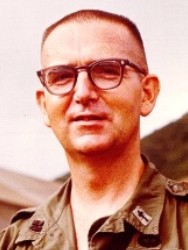
Joseph Watters graduated from Seaton Hall Preparatory Academy in Orange, New Jersey, before entering Seaton Hall University. He was at Seaton Hall for two years and then answered a call to the priesthood by entering the Immaculate Conception Seminary in Darlington, New Jersey. After six years of study he was ordained a Catholic Priest 1953. He earned a private pilotÕs license while he was a priest serving the local Parishes of the Archdiocese of New Jersey, in Jersey City, Paramus, Rutherford, and Cranford, and always had an interest in the sky. In 1962 he became a Chaplain for the New Jersey Air National Guard. In 1964 he entered military service as a U.S. Army Chaplain, including attending Jump School and earning his parachute wings. Promoted to captain, he joined the 173d Airborne Brigade in Vietnam in July 1966. He was the nephew of Navy Boatswain’s Mate John J. Doran, who received the Medal of Honor in the Spanish-American War.

Sponsored by:

–
Cemetery:
Awards Received
-

Medal of Honor
-
Medal of Honor
Service:
United States ArmyRank:
Major (Chaplain’s Corps)Batallion:
173d Support BattalionRegiment:
173d Airborne BrigadeAction Date:
November 19, 1967
Department of the Army, General Orders No. 71 (November 20, 1969)The President of the United States of America, in the name of Congress, takes pride in presenting the Medal of Honor (Posthumously) to Major (Chaplain’s Corps) Charles Joseph Watters (ASN: 0-3139624), United States Army (Reserve), for conspicuous gallantry and intrepidity at the risk of his life above and beyond the call of duty while serving with Company A, 173d Support Battalion, 173d Airborne Brigade, in action against enemy aggressor forces in an assault on Hill 875, Dak To, Kontum Province, Republic of Vietnam, on 19 November 1967. Chaplain Watters was moving with one of the companies when it engaged a heavily armed enemy battalion. As the battle raged and the casualties mounted, Chaplain Watters, with complete disregard for his safety, rushed forward to the line of contact. Unarmed and completely exposed, he moved among, as well as in front of the advancing troops, giving aid to the wounded, assisting in their evacuation, giving words of encouragement, and administering the last rites to the dying. When a wounded paratrooper was standing in shock in front of the assaulting forces, Chaplain Watters ran forward, picked the man up on his shoulders and carried him to safety. As the troopers battled to the first enemy entrenchment, Chaplain Watters ran through the intense enemy fire to the front of the entrenchment to aid a fallen comrade. A short time later, the paratroopers pulled back in preparation for a second assault. Chaplain Watters exposed himself to both friendly and enemy fire between the two forces in order to recover two wounded soldiers. Later, when the battalion was forced to pull back into a perimeter, Chaplain Watters noticed that several wounded soldiers were lying outside the newly formed perimeter. Without hesitation and ignoring attempts to restrain him, Chaplain Watters left the perimeter three times in the face of small arms, automatic weapons, and mortar fire to carry and to assist the injured troopers to safety. Satisfied that all of the wounded were inside the perimeter, he began aiding the medics–applying field bandages to open wounds, obtaining and serving food and water, giving spiritual and mental strength and comfort. During his ministering, he moved out to the perimeter from position to position redistributing food and water, and tending to the needs of his men. Chaplain Watters was giving aid to the wounded when he himself was mortally wounded. Chaplain Watters’ unyielding perseverance and selfless devotion to his comrades was in keeping with the highest traditions of the United States Army.