The President of the United States of America, authorized by Act of Congress, July 2, 1926, takes pleasure in presenting a Fourth Bronze Oak Leaf Cluster in lieu of a Fifth Award of the Distinguished Flying Cross to Staff Sergeant James W. Burns, United States Air Force, for extraordinary achievement while participating in aerial flight as a CH-3E Helicopter Flight Engineer of the 21st Special Operations Squadron, in Southeast Asia on 18 September 1969. On that date while engaged in a highly sensitive counterinsurgency mission deep in hostile territory, Sergeant Burns, even though his helicopter was seriously damaged by over fourteen hits from hostile ground fire during the first sortie, repeatedly exposed himself to hostile fire for over three hours and airlifted seventy troops to a place of safety. The professional competence, aerial skill, and devotion to duty displayed by Sergeant Burns reflected great credit upon himself and the United States Air Force.

Sponsored by:

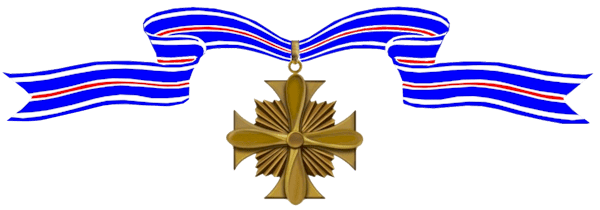
Awards Received
-
Distinguished Flying Cross
-
Distinguished Flying Cross
-
Distinguished Flying Cross
-
Distinguished Flying Cross
-
Distinguished Flying Cross
Service:
United States Air ForceRank:
Staff SergeantBatallion:
21st Special Operations SquadronAction Date:
November 18, 1969
The President of the United States of America, authorized by Act of Congress, July 2, 1926, takes pleasure in presenting a Bronze Oak Leaf Cluster in lieu of a Second Award of the Distinguished Flying Cross to Staff Sergeant James W. Burns, United States Air Force, for extraordinary achievement while participating in aerial flight as a Flight Engineer/Gunner on a CH-3E Helicopter of the 21st Special Operations Squadron, in Southeast Asia on 18 November 1969. On that date, Sergeant Burns with complete disregard of hostile automatic weapons fire and his own safety, stood unprotected in the cabin door of a hovering helicopter to rescue a Forward Reconnaissance Team that had suffered one killed and two wounded and was surrounded and under attack by hostile forces. Once the team was safely aboard the helicopter Sergeant Burns moved to the open cabin window firing his machine gun to suppress the hostile fire with deadly accuracy, unquestionably making possible their successful departure from the hostile area. Sergeant Burns’ heroic and decisive actions in the face of hostile automatic weapons fire resulted in the saving of the surviving team members from certain death or capture. The professional competence, aerial skill, and devotion to duty displayed by Sergeant Burns reflected great credit upon himself and the United States Air Force.
-
Distinguished Flying Cross
Service:
United States Air ForceRank:
Staff SergeantBatallion:
21st Special Operations SquadronAction Date:
March 24, 1970
The President of the United States of America, authorized by Act of Congress, July 2, 1926, takes pleasure in presenting a Third Bronze Oak Leaf Cluster in lieu of a Fourth Award of the Distinguished Flying Cross with Combat “V” to Staff Sergeant James W. Burns, United States Air Force, for heroism while participating in aerial flight as a Flight Engineer/Gunner on a CH-3E Helicopter of the 21st Special Operations Squadron, in Southeast Asia on 24 March 1970. On that date while landing in hostile territory to rescue a Forward Reconnaissance Team, Sergeant Burns fought and overcame heavy ground fire from a numerically superior hostile force. His steady and accurate fire not only shielded the team members from further injury as they boarded the helicopter, but also prevented the hostile force from damaging the helicopter during a critical phase of flight. The outstanding heroism and selfless devotion to duty displayed by Sergeant Burns reflected great credit upon himself and the United States Air Force.
-
Distinguished Flying Cross
Service:
United States Air ForceRank:
Staff SergeantBatallion:
20th Helicopter SquadronAction Date:
October 23, 1967
The President of the United States of America, authorized by Act of Congress, July 2, 1926, takes pleasure in presenting the Distinguished Flying Cross to Staff Sergeant James W. Burns, United States Air Force, for extraordinary achievement while participating in aerial flight as a UH-1F Helicopter Flight Mechanic in the 20th Helicopter Squadron, in Southeast Asia on 23 October 1967. On that date, Sergeant Burns took part in the rescue of a long-range reconnaissance team which was surrounded and under attack by hostile forces. On the approach and while on the landing zone, Sergeant Burns exposed himself in the open doorway to help clear the helicopter from the surrounding trees and to assist the teams members on board the aircraft. The professional competence, aerial skill and devotion to duty displayed by Sergeant Burns reflected great credit upon himself and the United States Air Force.
-
Distinguished Flying Cross
Service:
United States Air ForceRank:
Staff SergeantBatallion:
21st Special Operations SquadronAction Date:
December 3, 1969
The President of the United States of America, authorized by Act of Congress, July 2, 1926, takes pleasure in presenting a Second Bronze Oak Leaf Cluster in lieu of a Third Award of the Distinguished Flying Cross with Combat “V” to Staff Sergeant James W. Burns, United States Air Force, for heroism while participating in aerial flight as a Flight Engineer/Gunner CH-3E Helicopter of the 21st Special Operations Squadron, in Southeast Asia on 3 December 1969. On that date, Sergeant Burns heroically and unhesitatingly risked his life to rescue a six man Long Range Reconnaissance Team, which had suffered one wounded, and was under aggressive attack by a large hostile force. Sergeant Burns, ignoring the intense hostile automatic weapons fire, leaned out the door of his helicopter, in full view of the hostile troops fifty yards away, pulling the wounded team leader up the rope ladder and safely aboard the helicopter. During his departure from the landing zone he silenced at least one hostile gun position with his deadly accurate machine gun fire. The outstanding heroism and selfless devotion to duty displayed by Sergeant Burns reflected great credit upon himself and the United States Air Force.