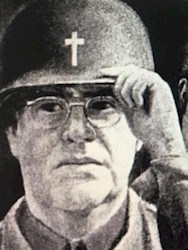
Gerald Quinn graduated from Xavier High School in New York City, and attended Woodstock College in Maryland. He entered the Jesuit Society on August 14, 1922, and was ordained a Catholic priest of the Jesuit order on June 23, 1935. In March 1943 he was appointed a U.S. Army chaplain and, after attending the ChaplainÕs School at Harvard University in May 1943, he was assigned to the 104th Division at Camp Adair, Oregon, and then Camp Carson, Colorado. He sailed with the Division to the European Theater of Operations in August 1944, arriving in France the following month. Two months later he was awarded the Silver Star for his actions during the fighting in Holland, and remained with the Division until the war ended. He was reverted to inactive status as a U.S. Army Reserve major on April 29, 1946. He served as administrator and treasurer of LeMoyne College in Syracuse in 1956 and 1947, and then served as rector and prefect at Canisius High School in Buffalo, New York, until 1959. He was director of the Jesuit retreat and mission teaching band and was the superior at the Jesuit provincial residence at Fordham from 1959 to 1965.

Sponsored by:

–
Born:
,
Home:
,
Buried:
,
Cemetery:
Awards Received
-

Silver Star
-
Silver Star
Service:
United States ArmyRank:
Captain (Chaplain’s Corps)Division:
104th Infantry DivisionAction Date:
October 26, 1944
Headquarters, 104th Infantry Division, General Orders No. 12 (1944)The President of the United States of America, authorized by Act of Congress July 9, 1918, takes pleasure in presenting the Silver Star to Captain (Chaplain’s Corps) Gerald A. Quinn (ASN: 0-517310), United States Army, for gallantry in action against the enemy while serving as a Chaplain with the 104th Infantry Division, in action in Holland, on 26 October 1944. The battalion to which Chaplain Quinn was assigned, while in the process of advancing in the early morning of 26 October 1944, was pinned down by enemy machine gun fire and subjected to severe enemy artillery and mortar fire throughout the day until evening. During this period of time, Chaplain Quinn constantly exposed himself to enemy fire while moving about the field of battle comforting the wounded. In one instance, in order to reach wounded man lying in ditch by main road, it was necessary for the Chaplain to move across an open field that was being raked by automatic fire from the enemy. After reaching the wounded man he returned under the same enemy fire and led litter bearers in the evacuation of the wounded man. The entire trip was exhausting and nerve-wracking but was performed in absolute coolness and determination of purpose. In the same field he administered to the dead while the battle was still raging about him. He showed concern for, and carefully evacuated the enemy dead and wounded as well. His prompt and courageous action aided in the quick evacuation and treatment of wounded men, and reflects great credit to himself and to the military service.