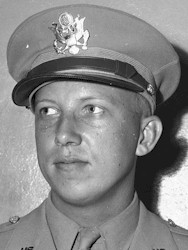
George Farmer’s family moved from Virginia to Saint Petersburg Florida in 1925, where he graduated from Saint Petersburg High School in 1936, and then attended Saint Petersburg Junior College, and Florida Southern College. He was ordained a Southern Baptist minister at Mirror Lake Christian Church in 1939. He moved to Texas where he pastored the Polytechnic Christian Church of Fort Worth, while doing graduate study at Texas Christian University. In 1943 he entered military service and was commissioned a U.S. Army chaplain. After attending the Chaplain’s School at Harvard University, he was assigned as a chaplain for the 95th Infantry Division, arriving in France in July 1944. While serving as chaplain, he was renown for establishing a “cussing fund,” where soldiers were fined a penny for each profanity uttered, with the money going to buy sacks and food for the troops. He returned to Florida and ministered in several churches there, with a brief absence when he served again as a chaplain during the Korean War. For three decades he taught in Pinellas Schools, and also taught psychology at Saint Petersburg and Seminole high schools, and was a guidance counselor at Tyrone Middle School until his retirement in 1975.

Sponsored by:

–
Born:
,
Home:
,
Buried:
,
Cemetery:
Awards Received
-

Silver Star
-
Silver Star
Service:
United States ArmyRank:
Captain (Chaplain’s Corps)Regiment:
379th Infantry RegimentDivision:
95th Infantry DivisionAction Date:
November 21 – 24, 1944
Headquarters, 95th Infantry Division, General Orders No. 43 (1945)The President of the United States of America, authorized by Act of Congress July 9, 1918, takes pleasure in presenting the Silver Star to Captain (Chaplain’s Corps) George Charlton Farmer, United States Army, for gallantry in action against the enemy while serving as a chaplain with the 379th Infantry Regiment, 95th Infantry Division, in action in France from 21 to 24 November 1944. During the initial assault on Fort Jeanne D’Arc, Chaplain Farmer joined the medical detachment and assisted in giving medical aid on the battlefield and in evacuating the wounded from the field of battle. Casualties were caused by sustained and highly accurate machine gun and mortar fire, and at times, shells burst so near to Chaplain Farmer that witnesses were sure he had been hit. For four days in this one battle, Chaplain Farmer risked his life on this voluntary mission to save the lives of others. His actions were an inspiration to all who saw him. The gallant actions and dedicated devotion to duty demonstrated by Chaplain Farmer, without regard for his own life, were in keeping with the highest traditions of military service and reflect great credit upon himself and the United States Army.